Many brands rely on push notifications and in-app messages to communicate with their users. While both channels are effective in the moment, they share a common limitation: they are short-lived. Once dismissed or ignored, these messages are no longer accessible, even if they contain valuable content such as time-sensitive offers, reminders, or personalized recommendations.
App Cards, also known as an in-app message inbox or persistent message center, address this gap by introducing a persistent, in-app space where messages can live beyond their initial delivery. Instead of disappearing, messages remain accessible, allowing users to revisit them whenever it suits them. This creates a more flexible and user-friendly communication experience while helping brands extend the impact of their campaigns.
This article explains the following:
How does App Cards work?
App Cards are designed as a flexible, campaign-driven solution that enables customers to create and manage persistent in-app messages with full control over their lifecycle. Instead of relying on previously delivered messages, App Cards allow messages to be planned, designed, and launched as dedicated campaigns.
With App Cards, customers can define their audience, design message content, configure goals, and launch campaigns through a structured flow similar to other messaging channels. This approach provides greater control over content, timing, and overall campaign performance.
Messages are delivered to the app via payloads, and the app is responsible for rendering them within its own interface. This allows each customer to build a fully native inbox experience that aligns with their app’s design and user experience, while keeping messages accessible for users to revisit at any time.
Requirements
Before getting started, it is important to understand the technical expectations for implementing App Cards and how they fit into an existing app architecture.
App Cards are designed for customers who can implement and manage their own inbox UI. As there is no built-in interface provided, the app must handle how messages are displayed, interacted with, and tracked.
Customers are expected to integrate the SDK methods to fetch messages, render them in the app, and send engagement events such as views and clicks. This setup provides flexibility but requires a certain level of technical maturity.
App Cards will not be displayed on devices with SDK versions older than the following versions:
Android 16.0.0
iOS 15.0.0
React Native 8.0.0
Flutter 5.0.0
Cordova 4.0.1
Feature set
App Cards bring together campaign management, flexible content options, and performance tracking in a single flow, allowing customers to control the full lifecycle of their messages.
Campaign-based setup with audience targeting, real-time reach estimation, and a structured creation flow from design to launch
Flexible content formats including text, single image, and multi-image carousel, with support for titles, descriptions, and dynamic content
Built-in AI assistance for generating message copy and improving content quality
Deep linking capabilities to drive users to specific areas within the app
A/B testing support with multiple variants and controlled audience distribution
End-to-end tracking, including delivery, view, and click events, along with read/unread status for inbox-level experiences
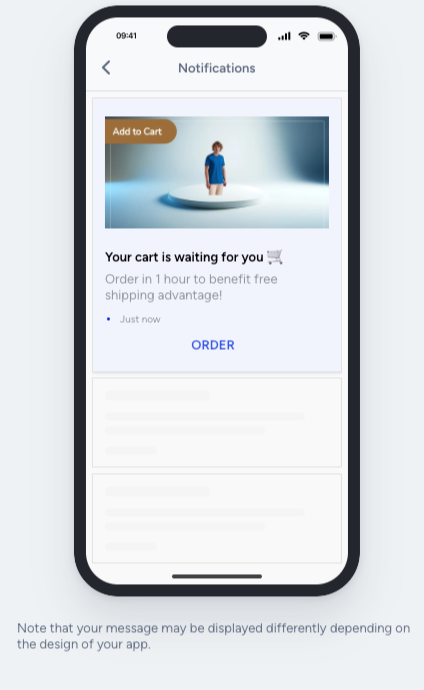
Preview functionality to visualize messages before launch (with the final appearance depending on the app implementation)
Use cases
App Cards can support a variety of communication scenarios across different industries, especially where users may need to revisit information later.
Keeping promotional offers accessible so users can return and redeem them later
Allowing users to revisit travel details, booking confirmations, or reminders at their convenience
Supporting financial applications with persistent alerts, summaries, or account-related updates
Providing service-based apps with a place to store recommendations, updates, or follow-ups
Enabling re-engagement strategies by targeting users who received messages but did not interact with them
Limitations and considerations
While App Cards provide flexibility and persistence, keep a few important considerations in mind when planning the implementation.
No built-in inbox UI, meaning customers are responsible for designing and implementing their own interface
Requires technical integration for rendering messages and sending engagement events
Message preview during campaign setup is indicative and may not fully match the final in-app rendering
Overall, App Cards provide a flexible and scalable way to extend the lifespan of mobile messages, making them accessible, actionable, and measurable beyond the moment of delivery.