Requirements
To start using the conversion push, you need to complete the following requirements.
Integrate the basic SDK version.
Integrate the dedicated events and attributes to segment users, personalize push notification content, and trigger campaigns.
The mobile push opt-in must be true for the user to receive app push notifications.
Your account must have at least one certificate uploaded.
Use Cases
To get a better understanding of how and when to use the conversion app push, refer to Use Cases for Conversion App Push.
A conversion push is an automated campaign triggered by user behavior on the app. Conversion scenarios work as short funnels. You expect the user to complete certain steps. If they do not, you send them a push notification.
You should complete the following steps to launch a campaign with the conversion push:
1. Create a campaign
2. Select a segment
3. Select conversion rule
4. Design your message
5. Test your campaign
6. Select goals
7. Configure the launch
8. View analytics
1. Create a campaign
1. Navigate to Campaigns > Messaging > App Push..png)
2. Click the Create button to start creating your campaign..png)
3. Select the Conversion push and a campaign operating system, and click the Create button.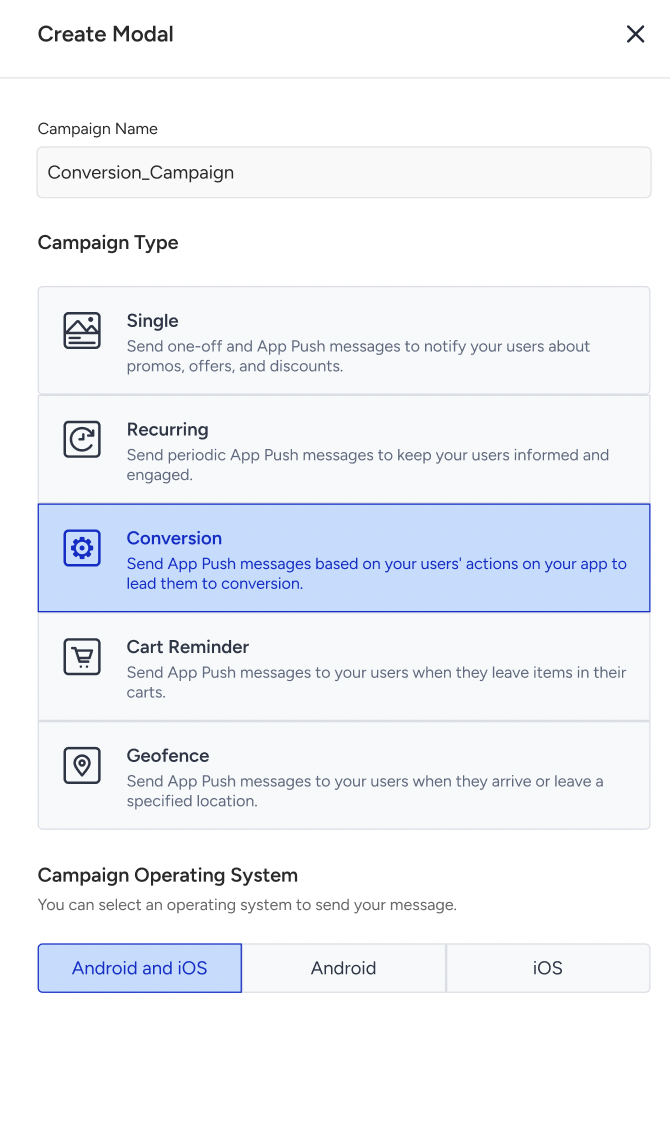
2. Select a segment
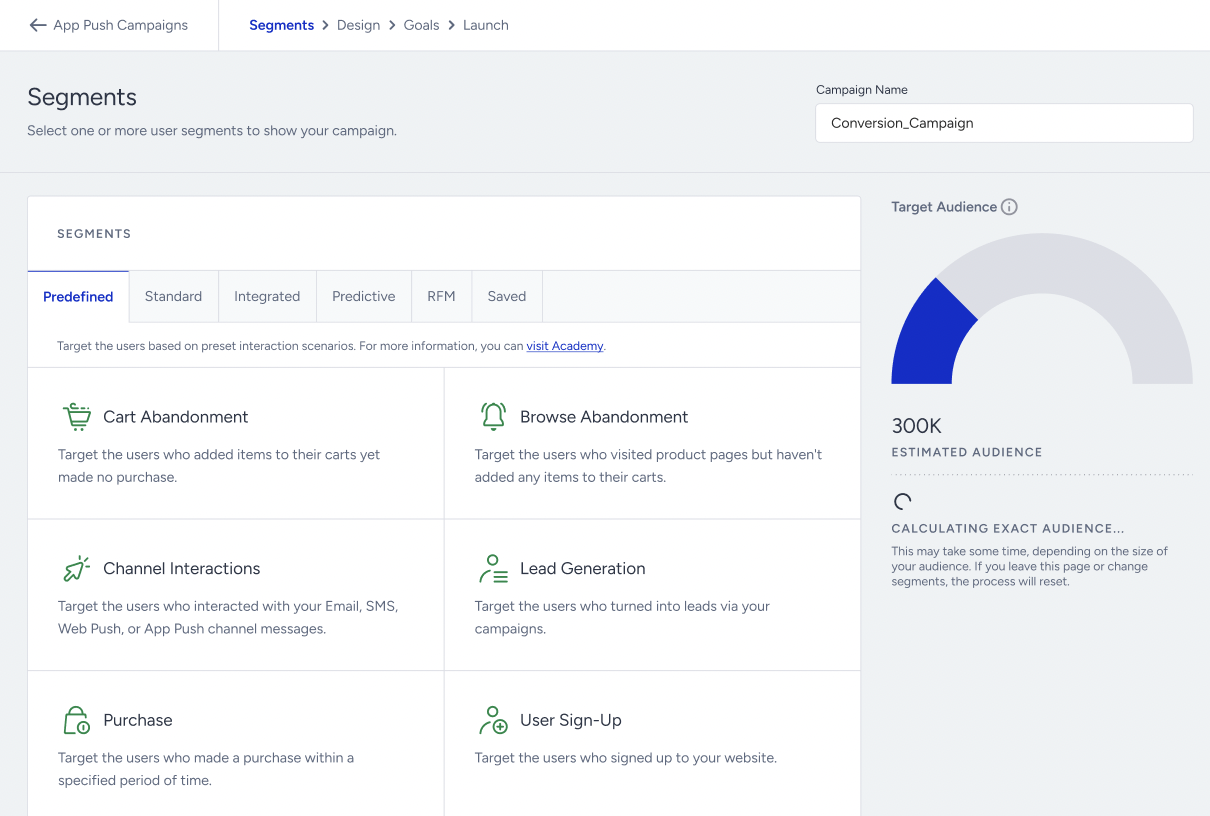
You can get an exact audience and select from Predefined Segments, Standard Segments, Integrated Segments, Predictive Segments, RFM Segments, and Saved Segments.
3. Select conversion rule
A conversion push requires a conversion trigger.
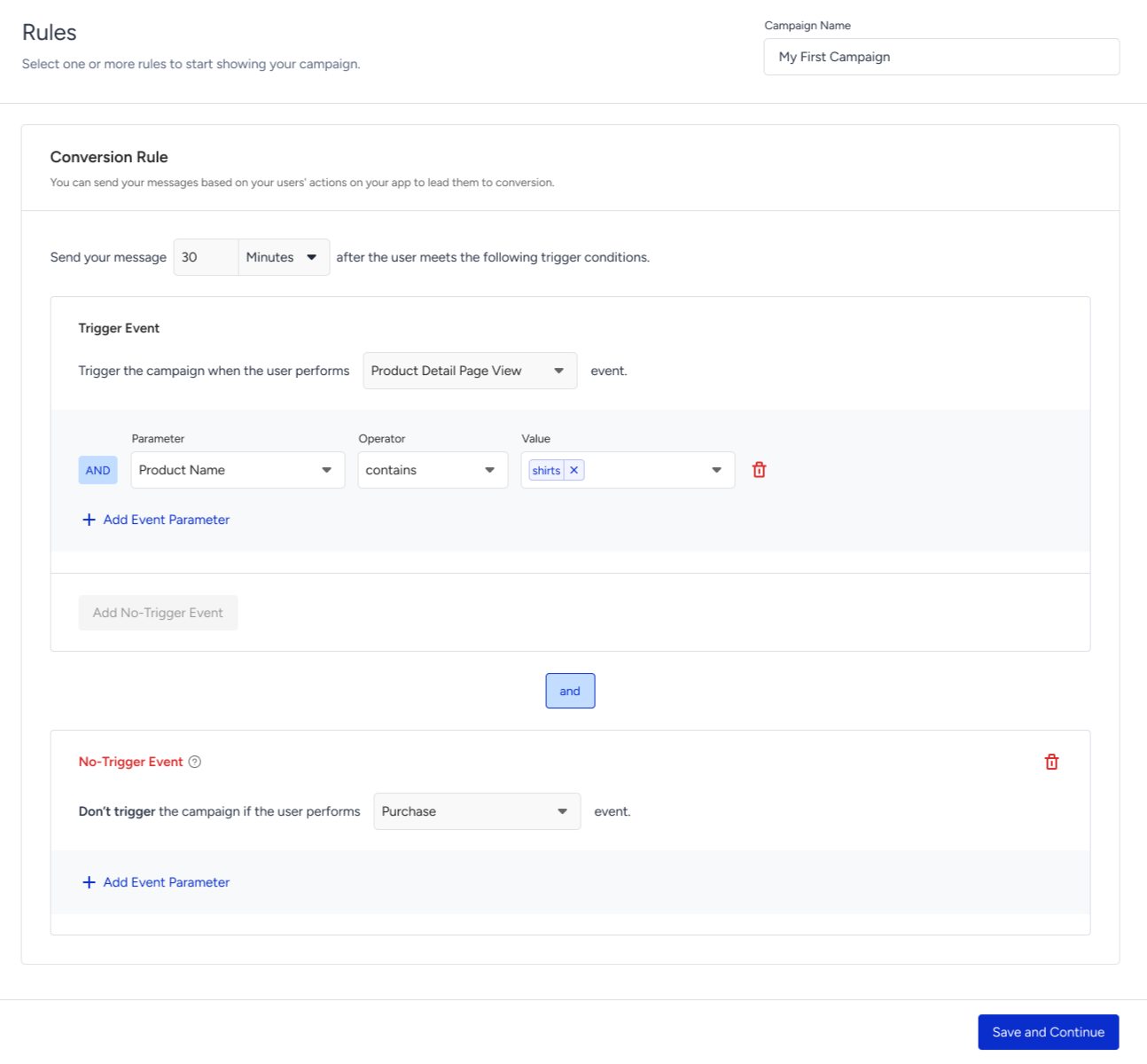
1. Set how much time later to send the push notification.
2. Choose an event that the users should complete. You can also add another one that they do not complete to trigger the push notification. You can also use the event parameters to target more specific actions.
The No-Trigger Event lets you prevent the campaign from being triggered for the users who perform the selected event in the set period of time.
Unsupported events and event parameters in app rules and goals
What are app-related events and parameters?
App-related events and parameters are the events sent by Insider One’s Mobile SDK from within the app. These include both custom events implemented by your developers during the SDK integration and the SDK's built-in events. Since the list displayed in the panel is generated across all apps in your account, it may also include events and parameters that your application does not actually send.
Why might a campaign not work?
App Templates and Conversion Push triggers are evaluated on the device using the events collected by Insider One’s Mobile SDK during the current app session. If your application never sends the selected event, the trigger condition can never be met. Likewise, if you create a filter using a parameter that your application does not send, the condition will never be satisfied.
What happens if you select an unavailable event or parameter?
The panel does not validate these selections or display a warning. The campaign can still be saved, but it will never be triggered, and any campaign goal based on unavailable events or parameters will not collect data. For this reason, we recommend confirming that the selected events and parameters are implemented before using them in your campaign.
4. Design your message
1. Select Icon or Single Image for your push notification. An icon push is a push with no uploaded image but the app icon while a single image push is a push with an image.
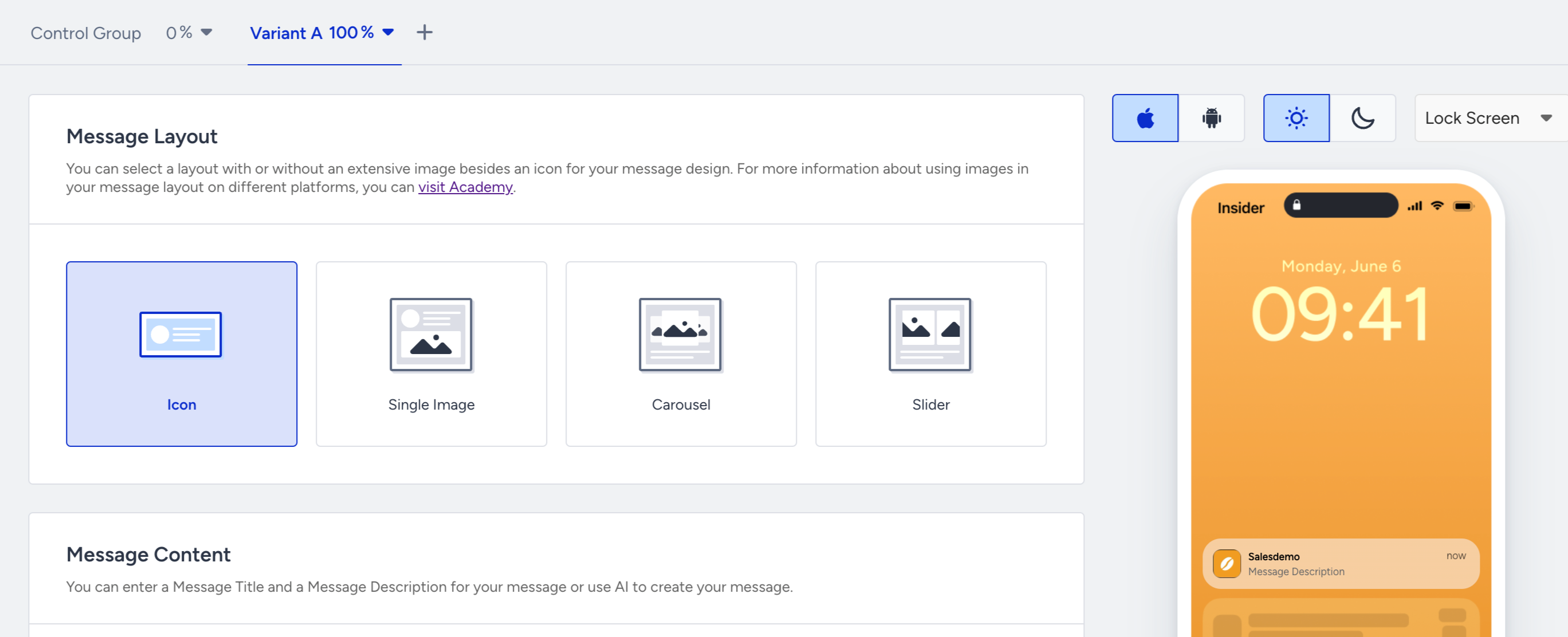
For the icon push, add your Message Title and Description.
For a single image, click the Upload Image button to add it. You can upload an image in JPG, JPEG, GIF, and PNG formats, up to 2MB and 2048x2048 pixels. The recommended size is 1024x512 pixels and a 2:1 aspect ratio.
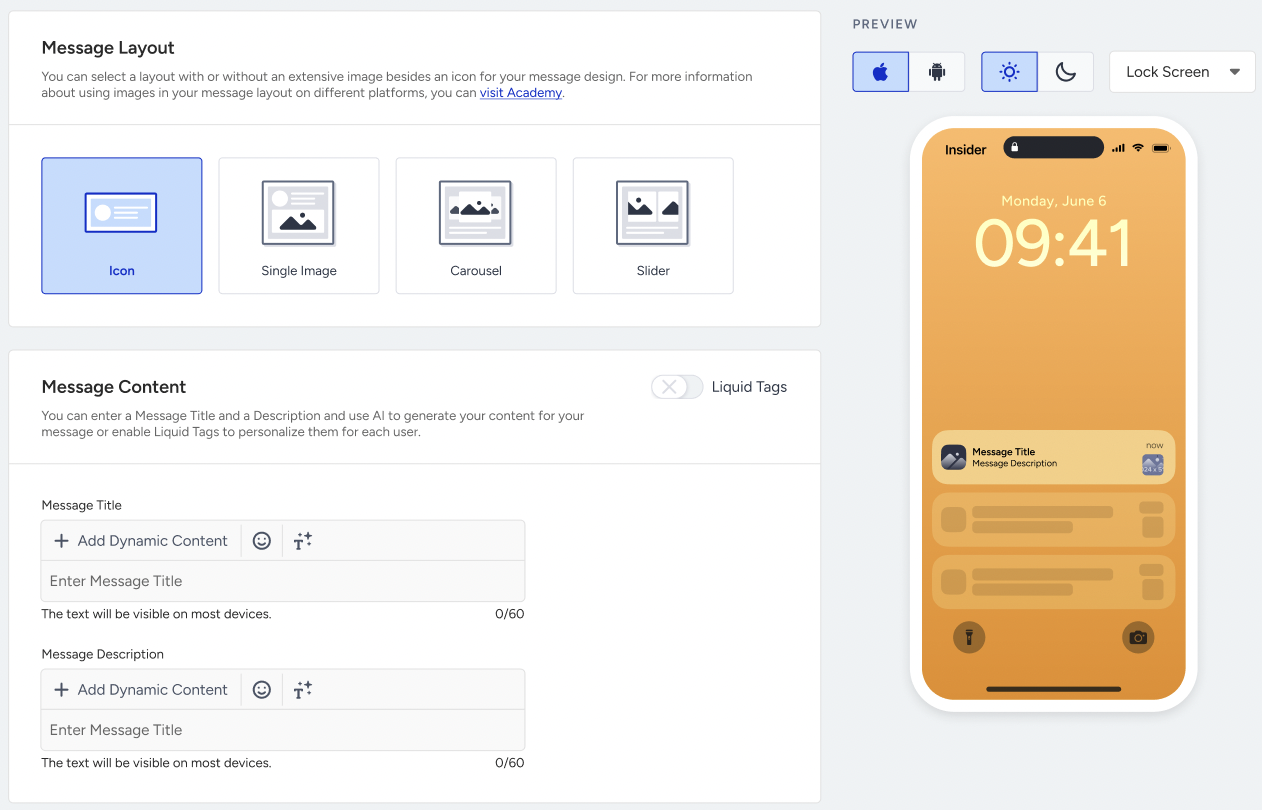
2. With the Add Dynamic Content button in the input areas, you can use the user attributes to personalize your message content for each user. You can insert the selected attribute where your typing cursor is.
Attributes also need a fallback value in case some users in the segment do not have a value for the respective attribute. For example, a user may not be logged in in the app, and the name attribute for that user may not be available at that time.
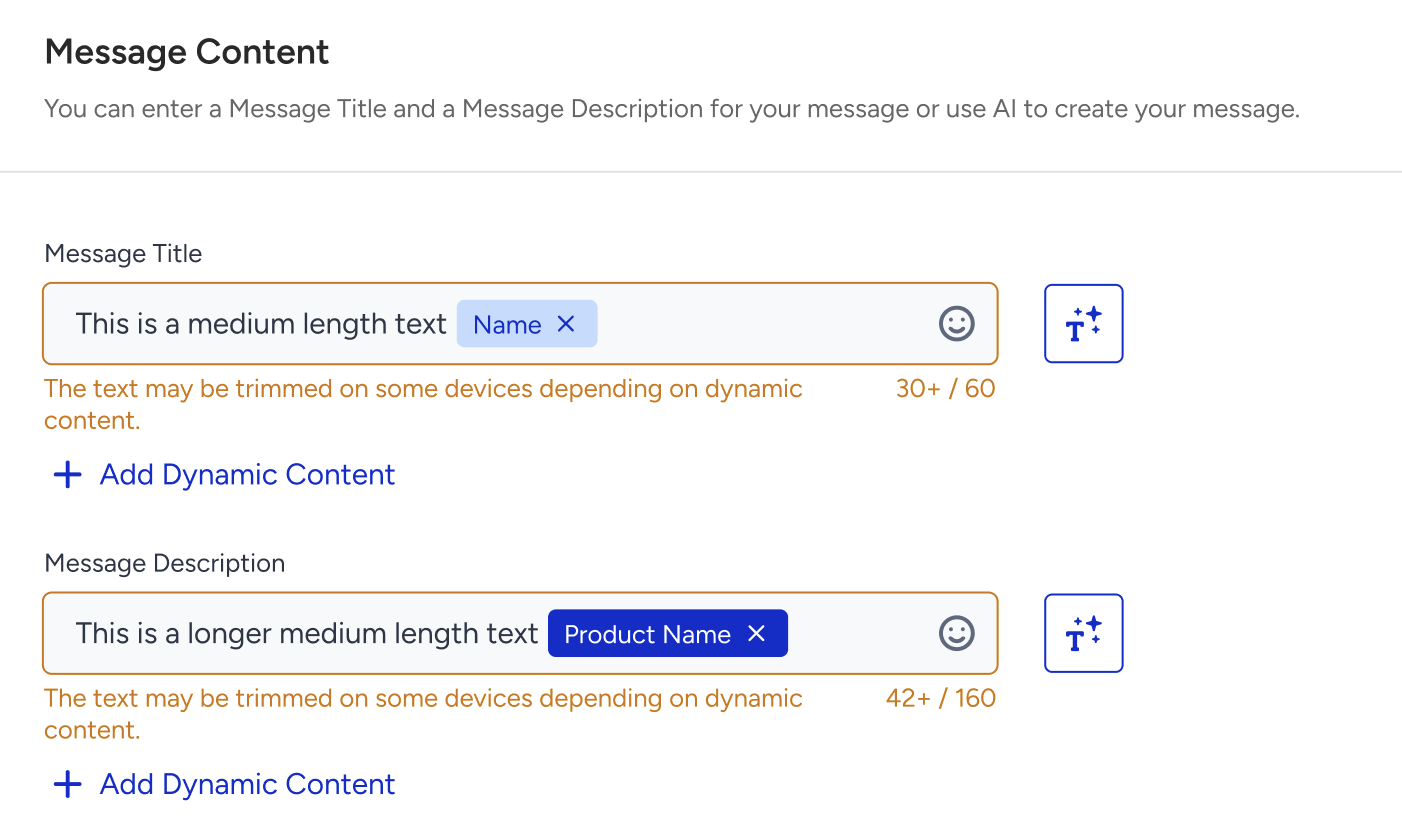
3. Click the emoji button against the Title and Message input areas to add emojis.
4. To use an AI-generated text:
Click the Generate Text button to see the side modal.
Enter a prompt you want to generate the text about.
The language option will be the default selected language of your panel.
Select your industry and use case to define the context for the text to be generated.
Click the Generate Copy button.
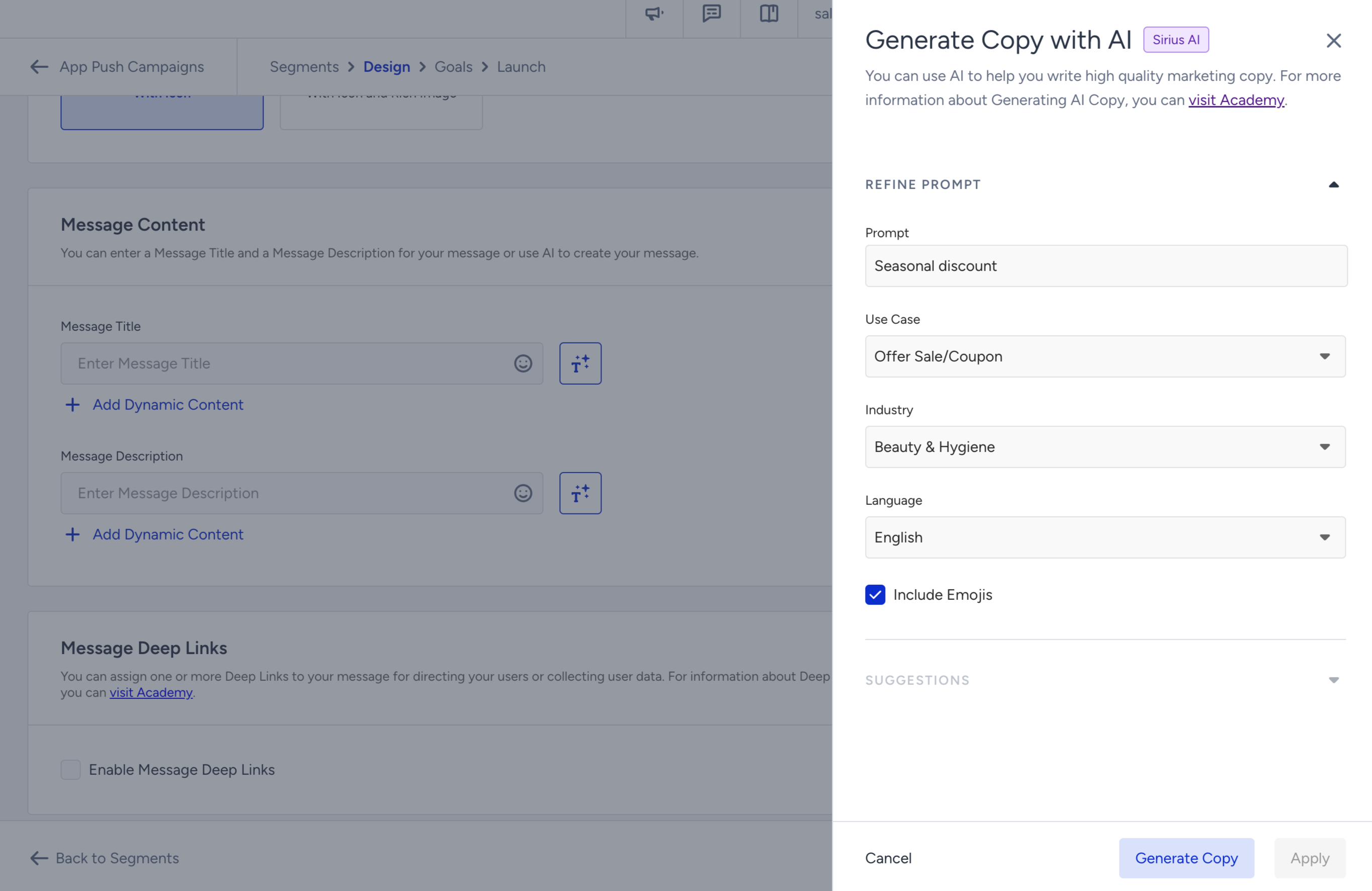
If you want to include emojis in your copy, you can check the "Include Emojis" box.
This option indicates that the AI can generate copies with emojis. However, not all options might include emojis.
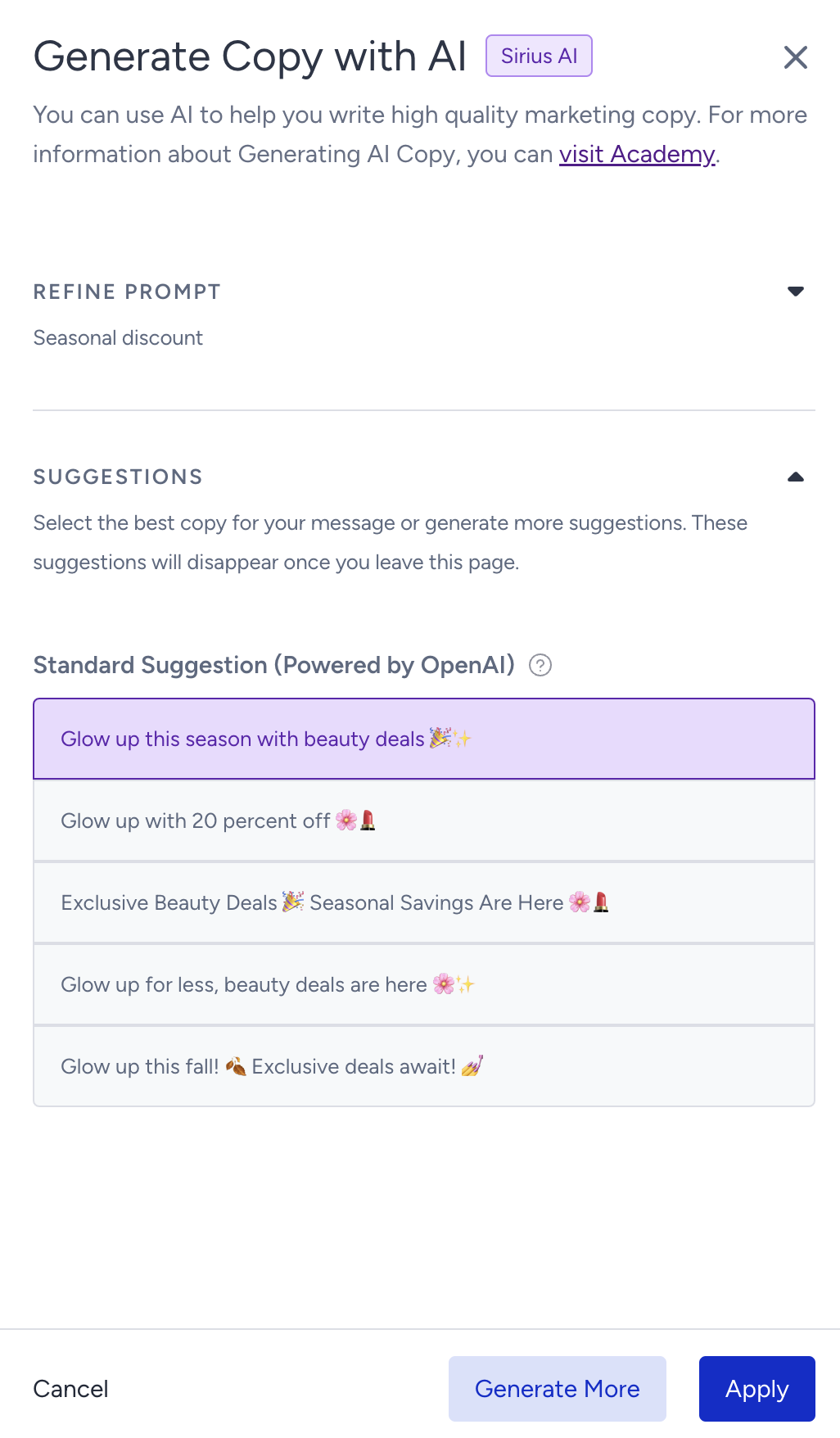
The modal displays 5 suggestions. To see more, you can click the Generate More button. To use any suggestion, you can select it and click the Apply button. Once you click the Apply button, the copy will be added to the respective field.
5. To add a deep link to the push message, check the Enable Message Deep Links box.
(1).png)
Select one of the deep link types to enter your key and value or add an existing deep link. Read more on deep links.
%20(1).png)
You can also use attributes as the deep link value. This means that the deep link value will change for all users who have that value, and each user will be redirected to a personalized page (e.g., last visited product).
Add push CTA buttons
6. You can configure CTA buttons without requiring any development effort to:
Seamlessly switch push notification types to include actionable buttons.
Define multiple button actions within a single notification to expand redirection options.
Customize button texts and deep links to align with your campaign goals.
Manage all configurations directly within the panel, eliminating the need for developer involvement or app updates.
Segment CTA buttons by user attributes, behaviors, or other targeting criteria to ensure more personalized and relevant interactions.
Create richer, more interactive app push experiences that drive engagement and conversions.
You can add the Message Action Buttons to campaigns that use Icon and Single Image message layouts. By default, Message Action Buttons are disabled.
The action buttons will be visible depending on your SDK version. To ensure clarity, the minimum required SDK versions are:
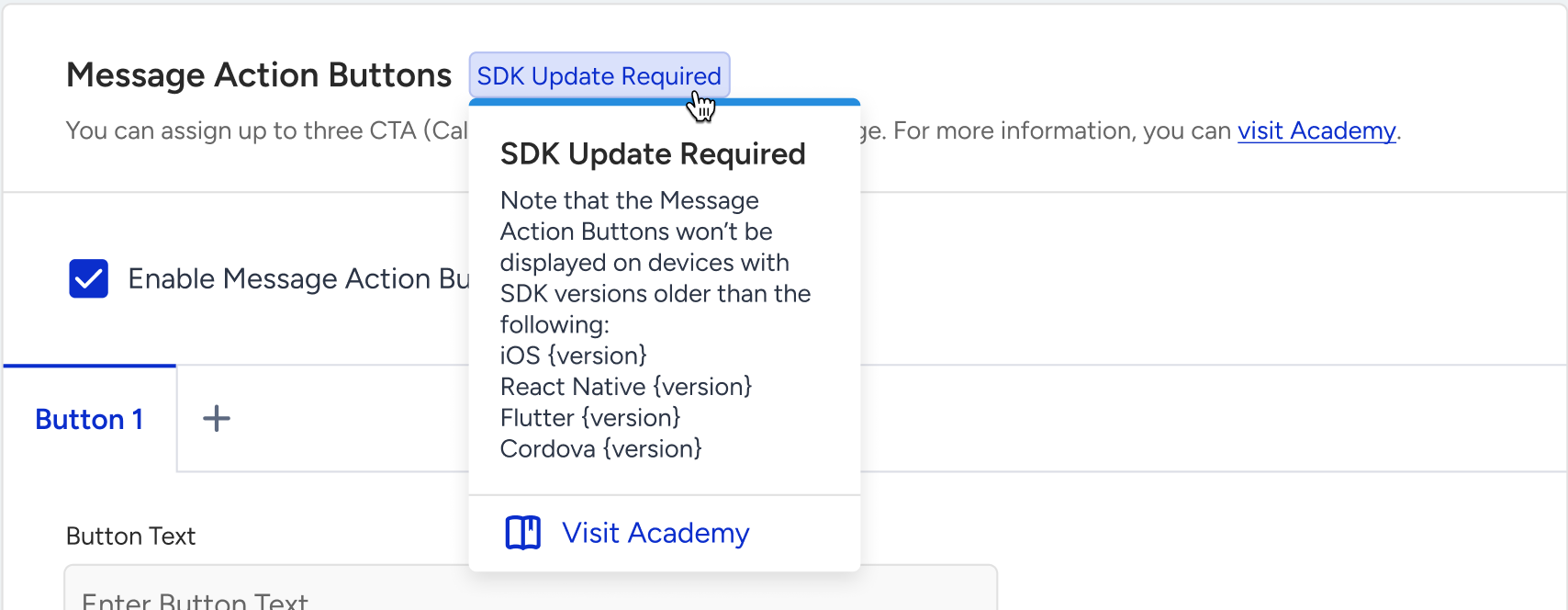
Once the action buttons are enabled, you can click the + (plus) sign to add up to three buttons. You can define a Button Text that determines how the button appears on end users' devices.
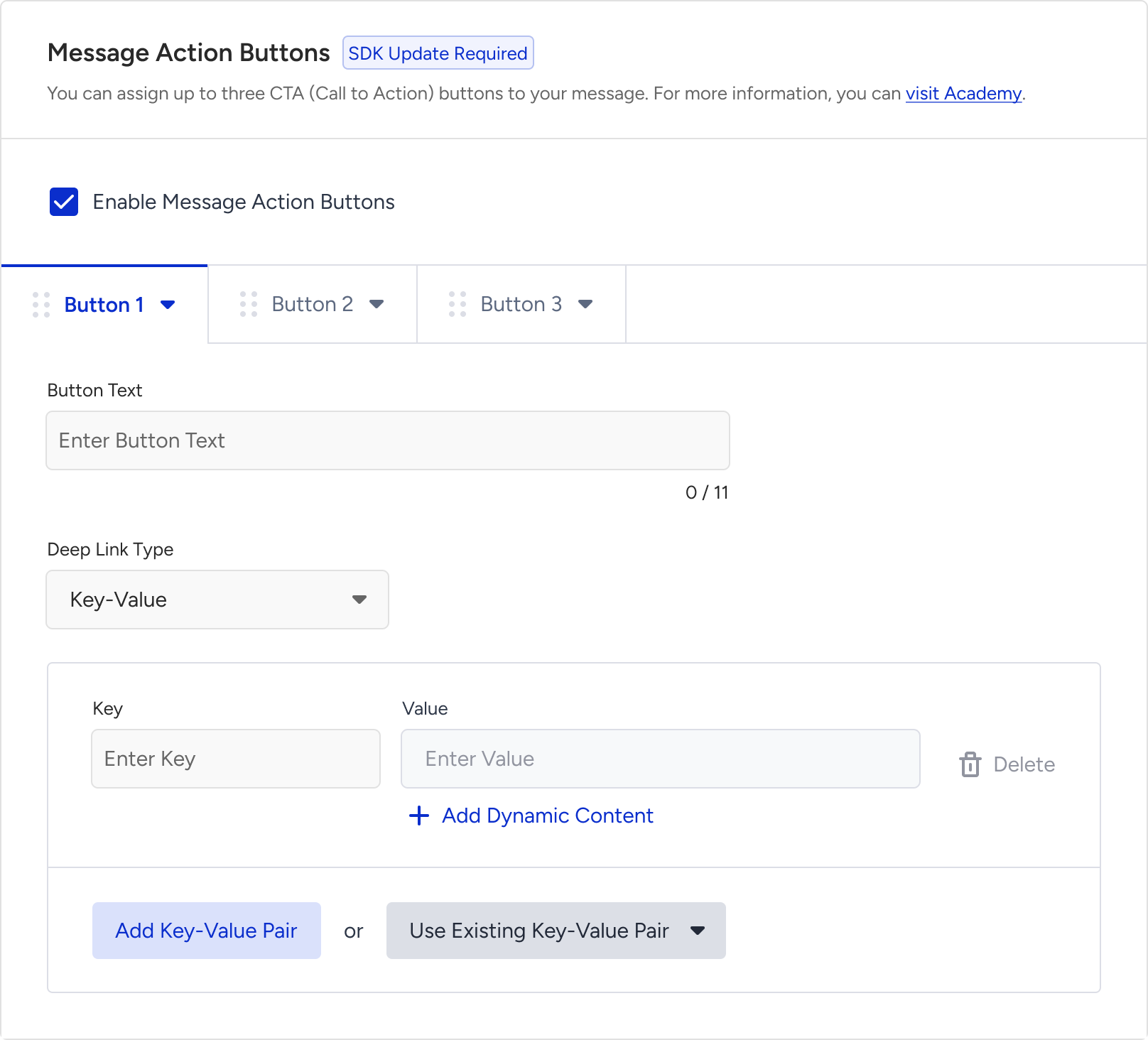
The maximum Button Text length varies depending on the number of buttons added:
1 button: Up to 48 characters
2 buttons: Up to 20 characters each
3 buttons: Up to 11 characters each
After adding the button text, you can assign a deep link to redirect those clicking the specific button. You can either add a new deep link of any type or select from the existing deep links you previously created.
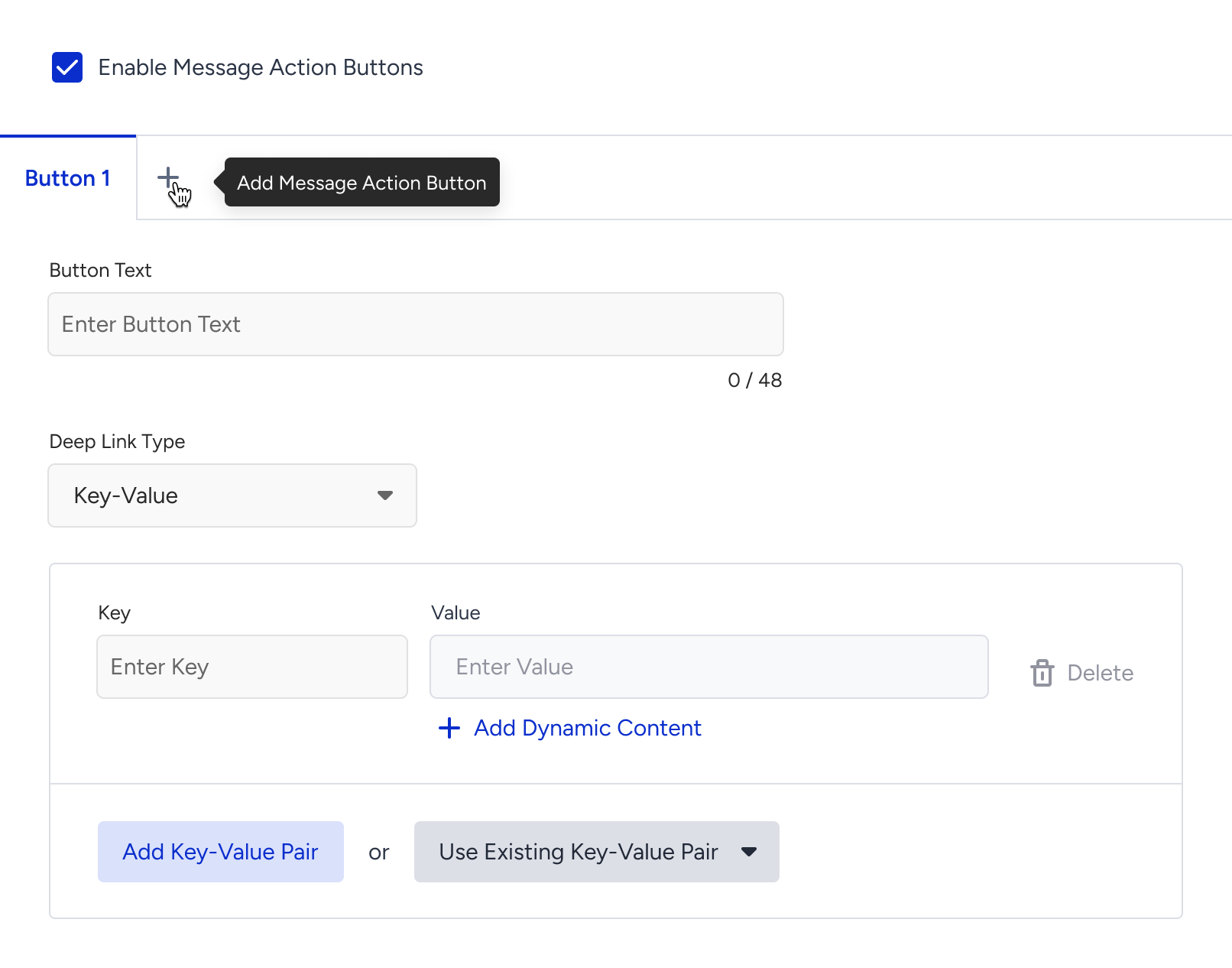
Once you add the maximum number of buttons (three), the "+" icon will disappear. You can drag the buttons to rearrange them.
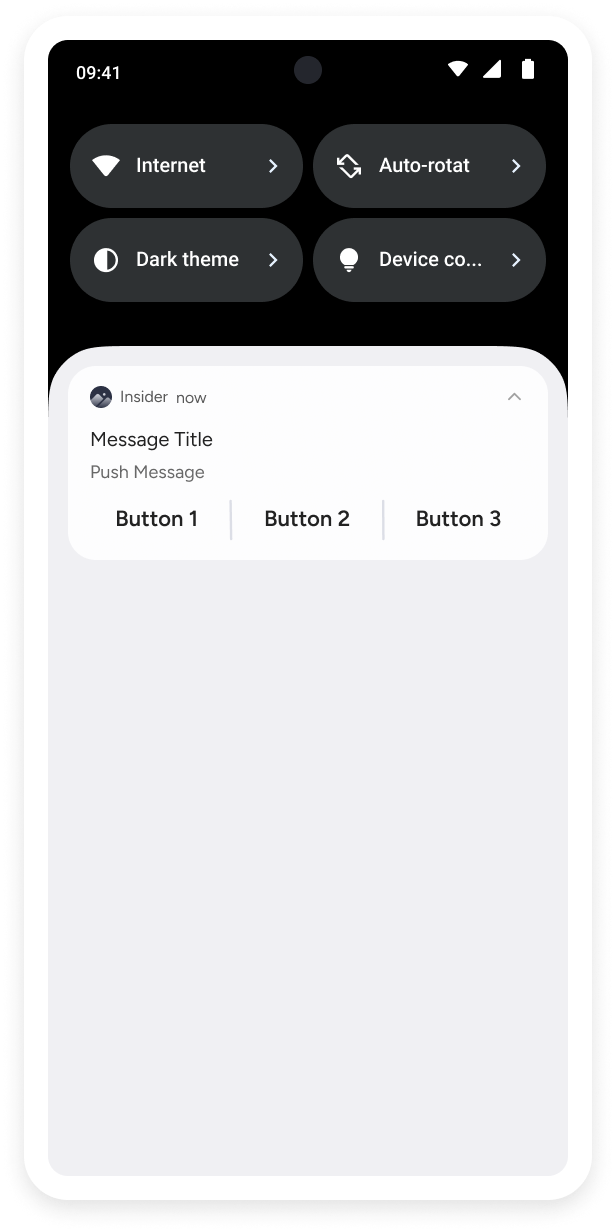
Additionally, previews will update dynamically based on the number of buttons and their content. This allows you to see a realistic preview of your campaign on both iOS and Android.
Below you can see some example previews:
|
|
.png)
Later, you can segment your users based on their clicks on the action buttons in the app push campaigns.
7. To run A/B/C tests, click the + (plus) button next to your variant. Then click the variant to change their percentage, duplicate it, or delete it.
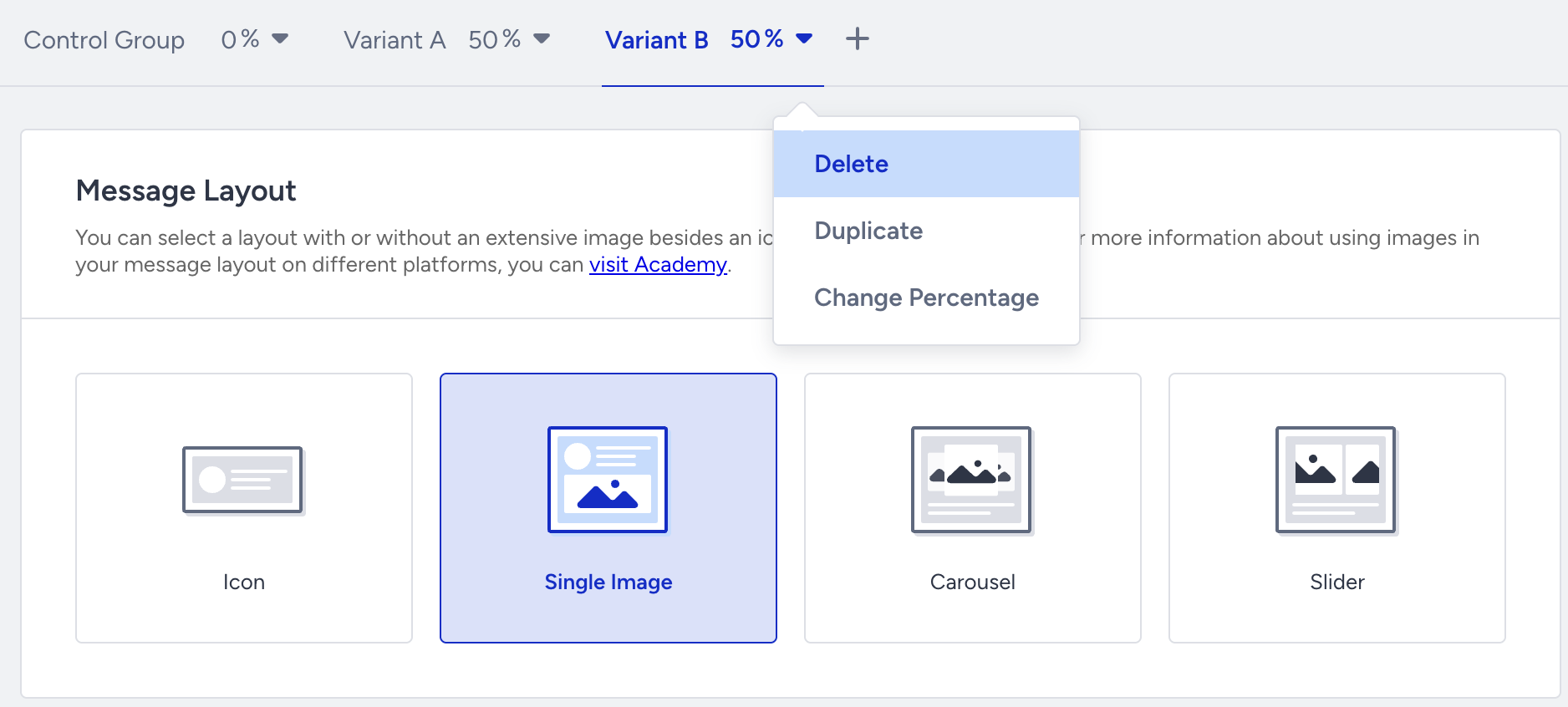
Control Group and Variant A are created by default when you create your push notification.
5. Test your campaign
You can preview your app pushes on the Design step while designing your message. The Test Message button helps you see the campaign preview on your device. You can select a test group and/or any individual user to test your message.
Refer to the Test page for instructions on testing your campaign.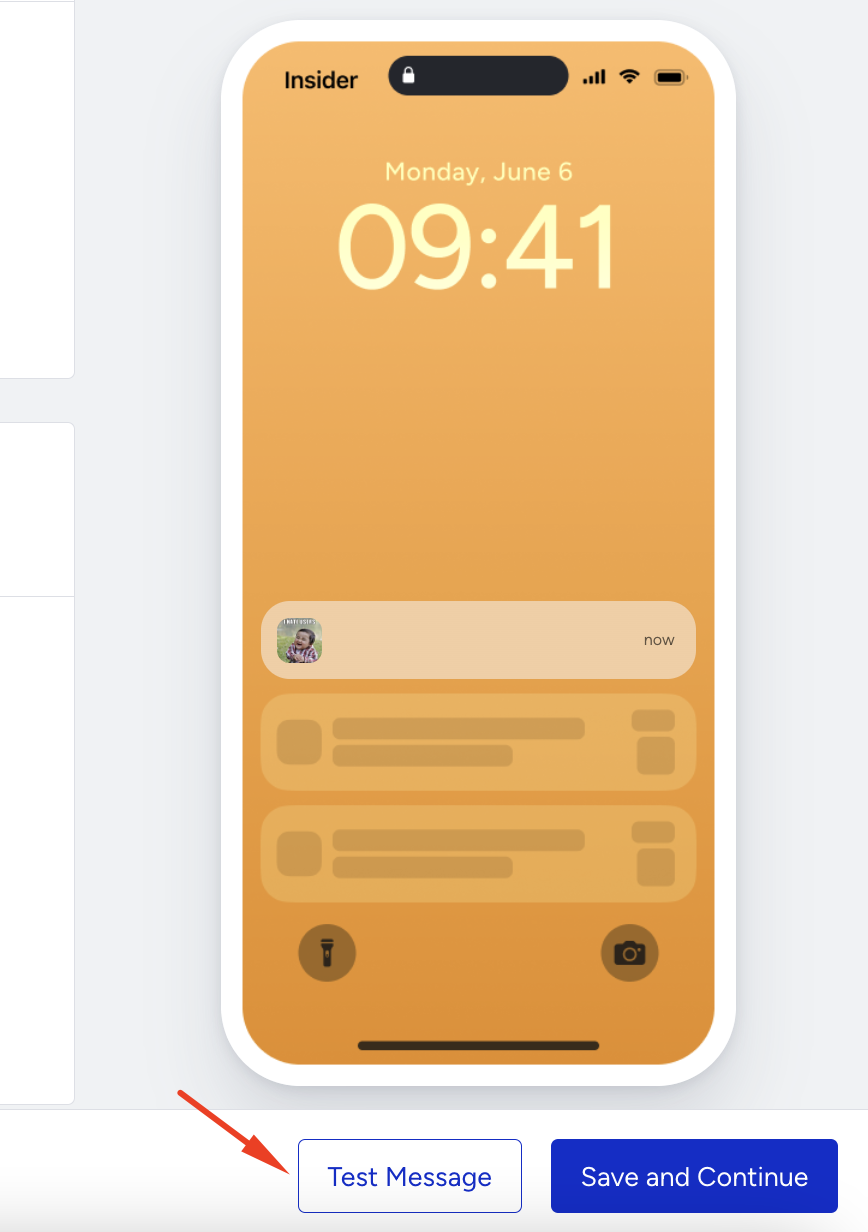
6. Select goals
The Goals step helps you create goals and configure conversion durations for your campaign.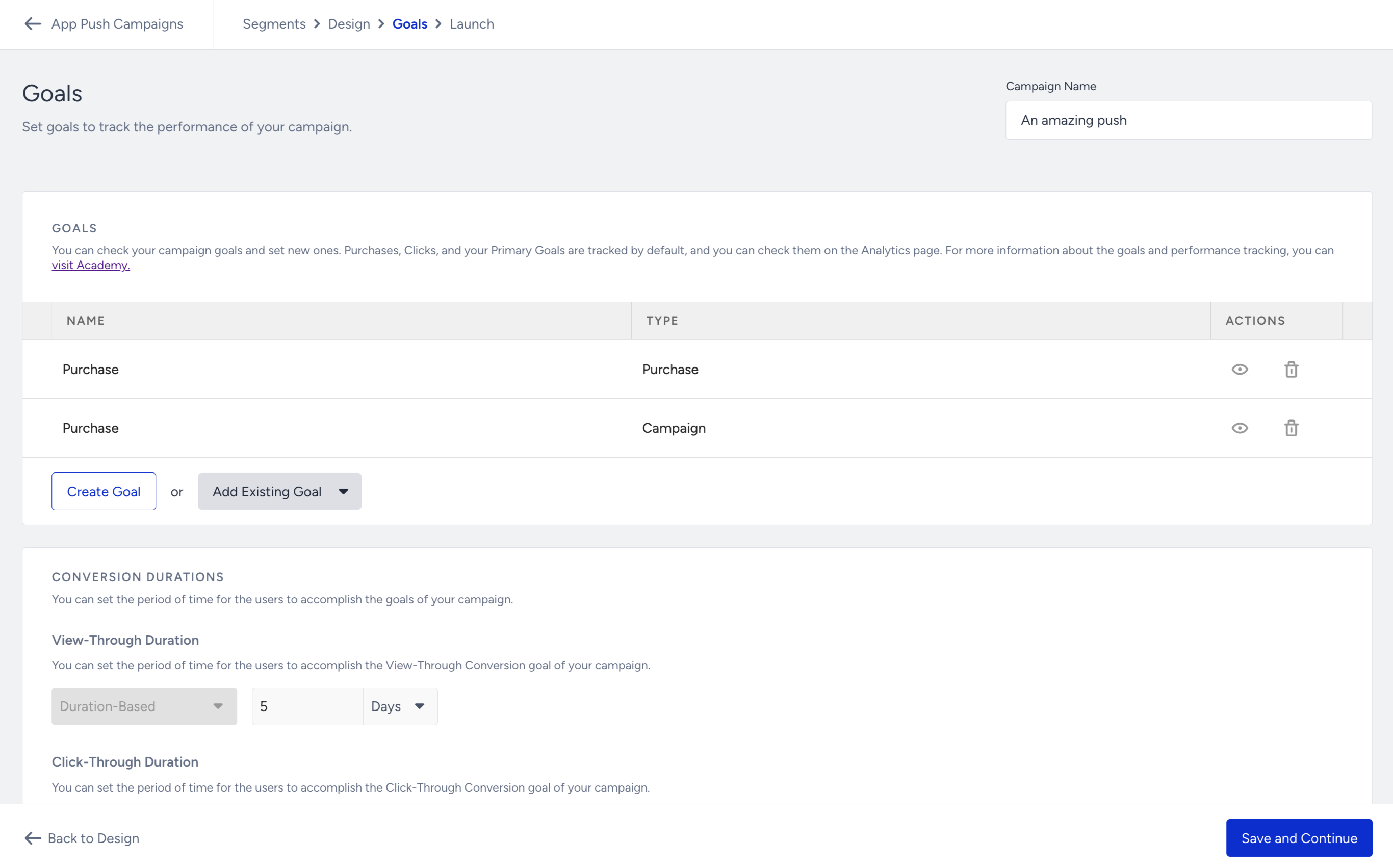
7. Configure the launch
Refer to the Launch page to configure Silent Hours, Send Time Optimization, Time to Live, Campaign Group Access, App Template Campaign Integration, Frequency Capping, Message Throttling, Notification Sounds, iOS Thread and Android Channels, and Campaign Tags.
8. View analytics
Go to the Analytics page to
View the summary metrics
Analyze the pie chart & graphs
View the variant list
Export your results
