Requirements
To start using the cart reminder push, you must complete the following requirements.
Integrate the SDK version 7.1 at least on both platforms
Integrate Carousel/Slider Push Notifications for iOS
Integrate Insider’s Revenue Tracking Method (Android, iOS, React Native, Flutter, Cordova)
Integrate Insider's Cart Reminder Method (Android, iOS, React Native, Flutter, Cordova)
Use the dedicated methods to pass the item name, item ID, item price, price currency, and item image to Insider with the 7.1 SDK or later.
The mobile push opt-in must be true for the user to receive app push notifications.
Your account must have at least one certificate uploaded.
Use Cases
To get a better understanding of how and when to use the cart reminder app push, refer to Use Cases for Cart Reminder App Push.
Abandoned carts have been a lasting problem for all ecommerce businesses. A cart reminder push helps you tackle this issue.
A cart reminder push is very similar to a conversion push. Provided that the integration is completed, a push is triggered when a user adds item(s) to their cart and ends the session. Depending on the number of items in the cart, the user will receive a rich push notification or a carousel push notification with the image, name, and price of the item(s).
If the cart contains one or two items, users will receive a standard rich notification that looks like a slider notification, without navigation arrows. It will include the last item added to the cart.
If the cart contains three or more items, users will receive a carousel notification that looks like a slider, showing all items. It is limited to a maximum of six items. If there are more than 6 items in the cart, it will display the last six items added.
You should complete the following steps to launch a campaign with the cart reminder push:
1. Create a campaign
2. Select a segment
3. Set cart reminder rule
4. Create your message
5. Test your campaign
6. Select goals
7. Configure the launch
8. View analytics
1. Create a campaign
1. Navigate to Campaigns > Messaging > App Push.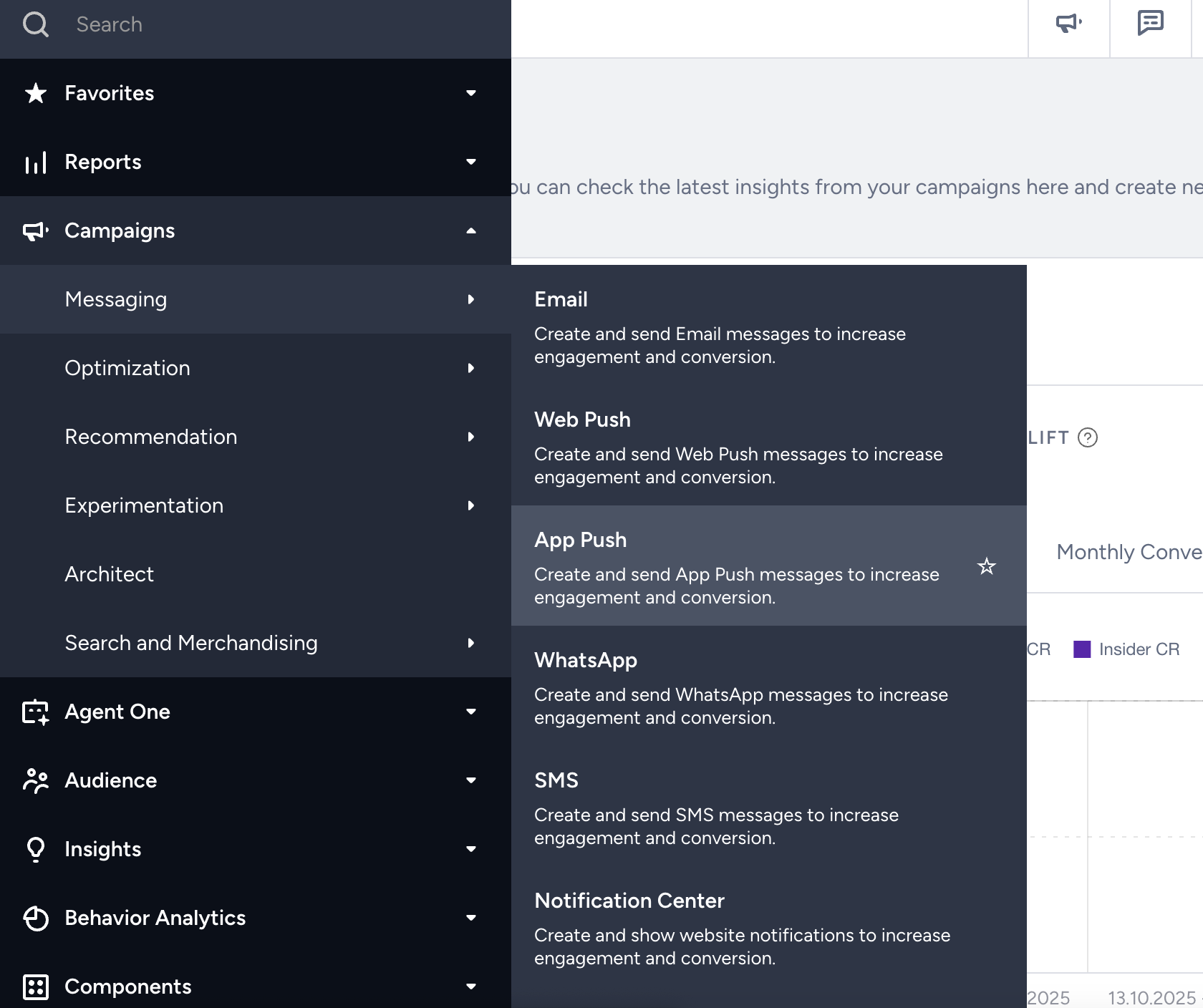
2. Click the Create button to start creating your campaign.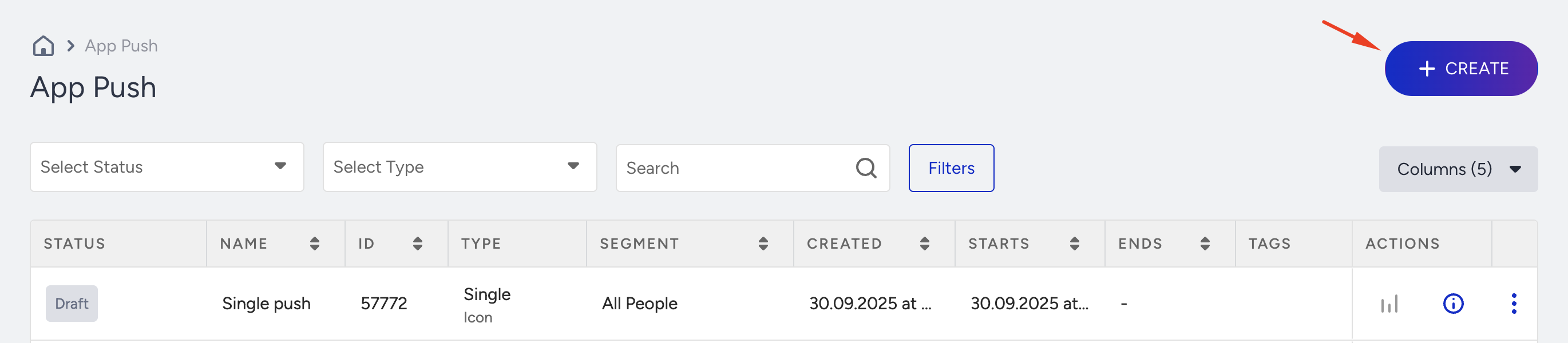
3. Select the Cart Reminder push and a campaign operating system, and click the Create button.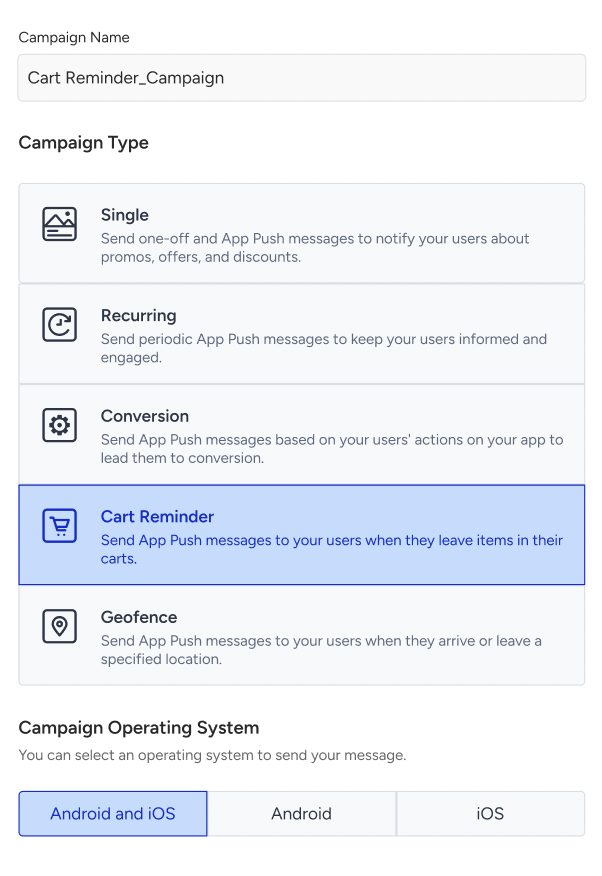
2. Select a segment
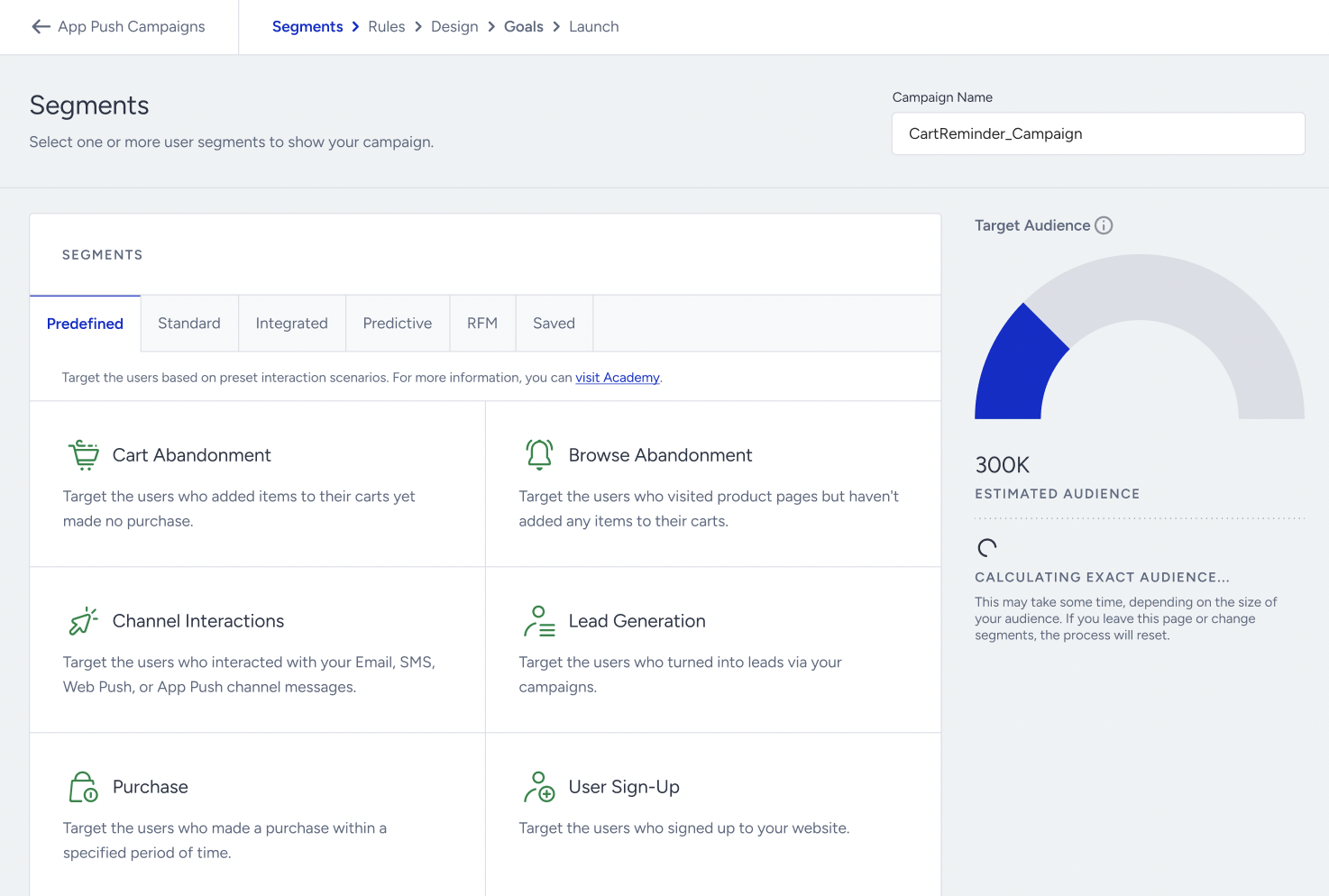
You can get an exact audience and select from Predefined Segments, Standard Segments, Integrated Segments, Predictive Segments, RFM Segments, and Saved Segments.
3. Set cart reminder rule
A cart reminder push requires a cart reminder trigger.

The trigger events are selected by default. You can set when to send the push notification after users add an item to their cart, but do not purchase it.
4. Create your message
1. To edit the push content, enter your title and message.
.png)
When users abandon their cart, Cart Reminder sends them rich notifications with the images of the items they abandoned. Cart Reminder will send the last item(s) added to the cart but not purchased.
If the user has three or more items in the cart, s/he will receive a carousel notification with the item images, names, and price.
If the user has less than three items in the cart, they’ll receive a slider push notification with the last item’s image, name, and price.
2. With the Add Dynamic Content button in the input areas, you can use the user attributes to personalize your message content for each user. You can insert the selected attribute where your typing cursor is.
Attributes also need a fallback value in case some users in the segment do not have a value for the respective attribute. For example, a user may not be logged in in the app, and the name attribute for that user may not be available at that time.
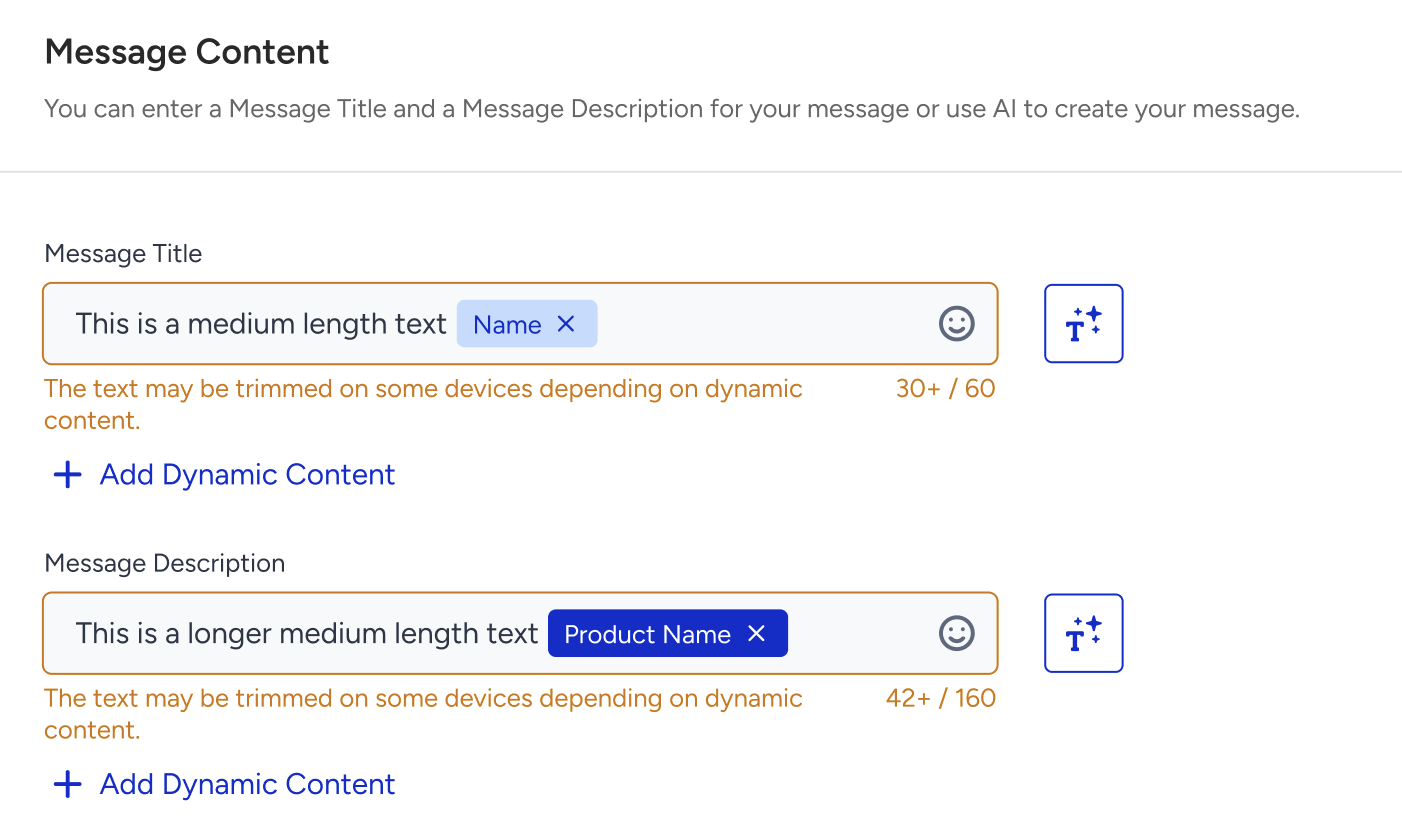
3. Click the emoji button against the Title and Message input areas to add emojis.
4. To use an AI-generated text:
Click the Generate Text button to see the side modal.
Enter a prompt you want to generate the text about.
The language option will be the default selected language of your panel.
Select your industry and use case to define the context for the text to be generated.
Click the Generate Copy button.
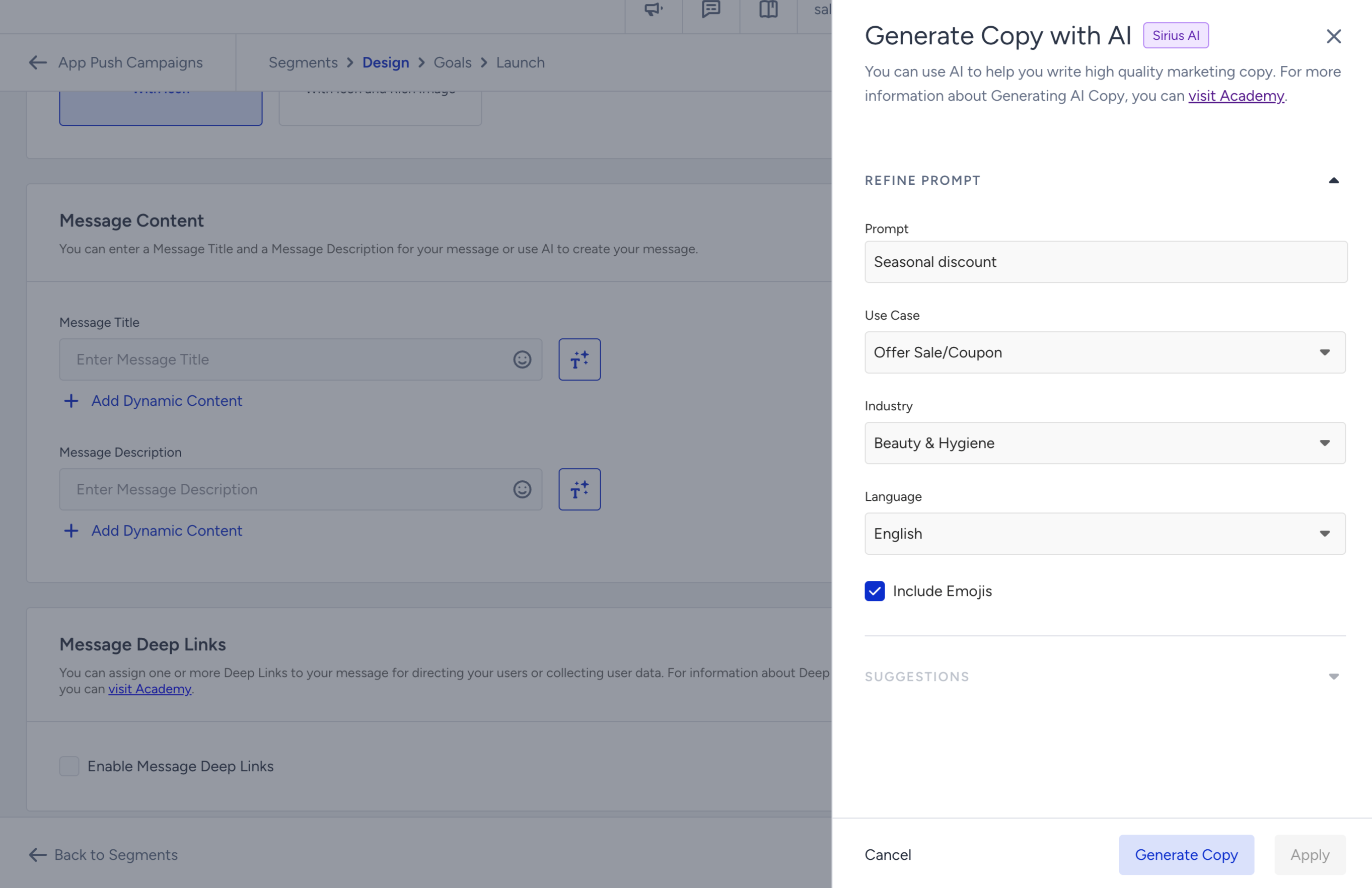
If you want to include emojis in your copy, you can check the "Include Emojis" box.
This option indicates that the AI can generate copies with emojis. However, not all options might include emojis.
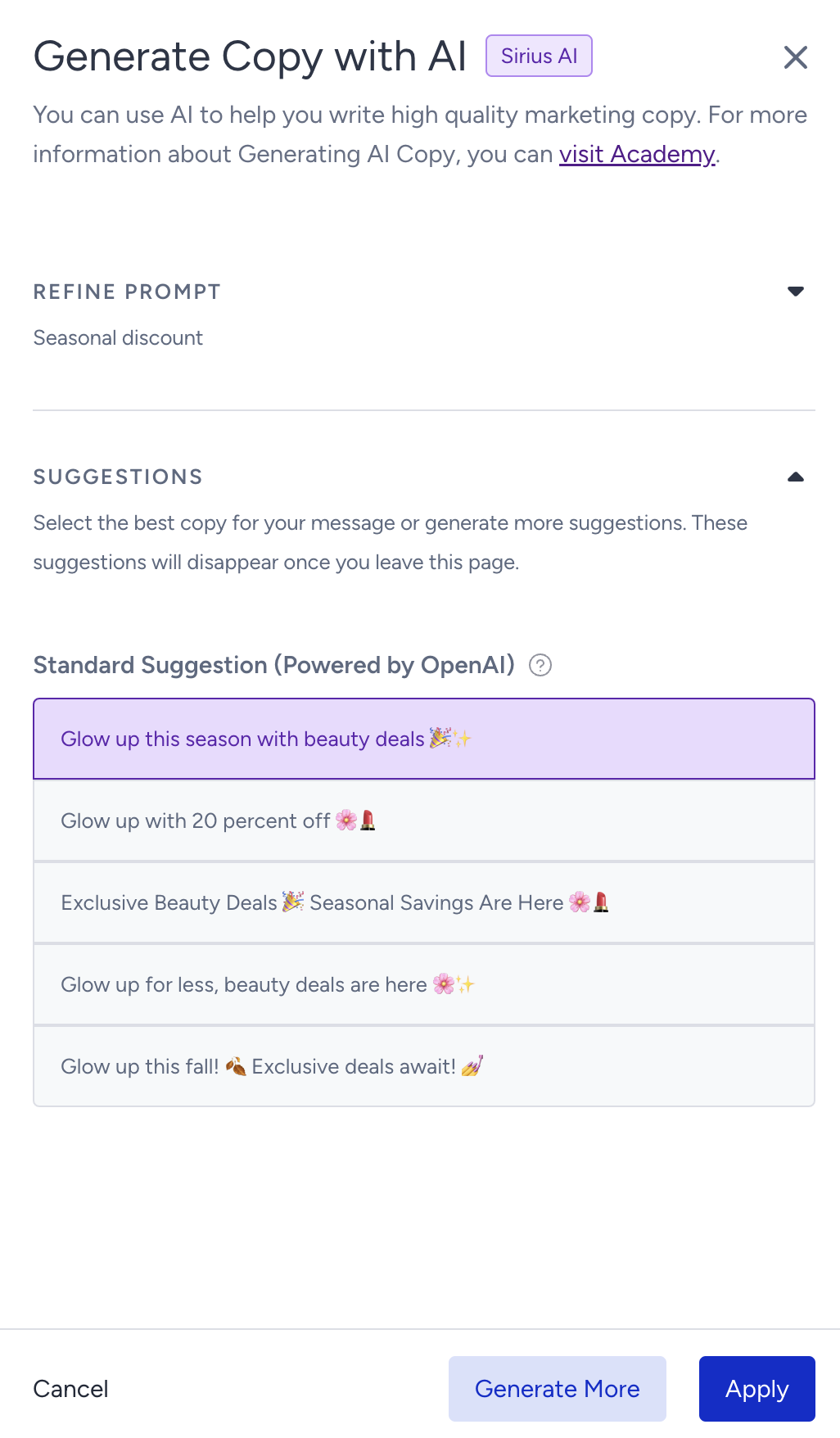
The modal displays 5 suggestions. To see more, you can click the Generate More button. To use any suggestion, you can select it and click the Apply button. Once you click the Apply button, the copy will be added to the respective field.
5. To add a deep link to the push message, check the Enable Message Deep Links box.
(1).png)
Select one of the deep link types to enter your key and value or add an existing deep link. Read more on deep links.
%20(1).png)
You can also use attributes as the deep link value. This means that the deep link value will change for all users who have that value, and each user will be redirected to a personalized page (e.g., last visited product).
5. Test your campaign
You can preview your app pushes on the Design step while designing your message. The Test Message button helps you see the campaign preview on your device. You can select a test group and/or any individual user to test your message.
Refer to the Test page for instructions on testing your campaign.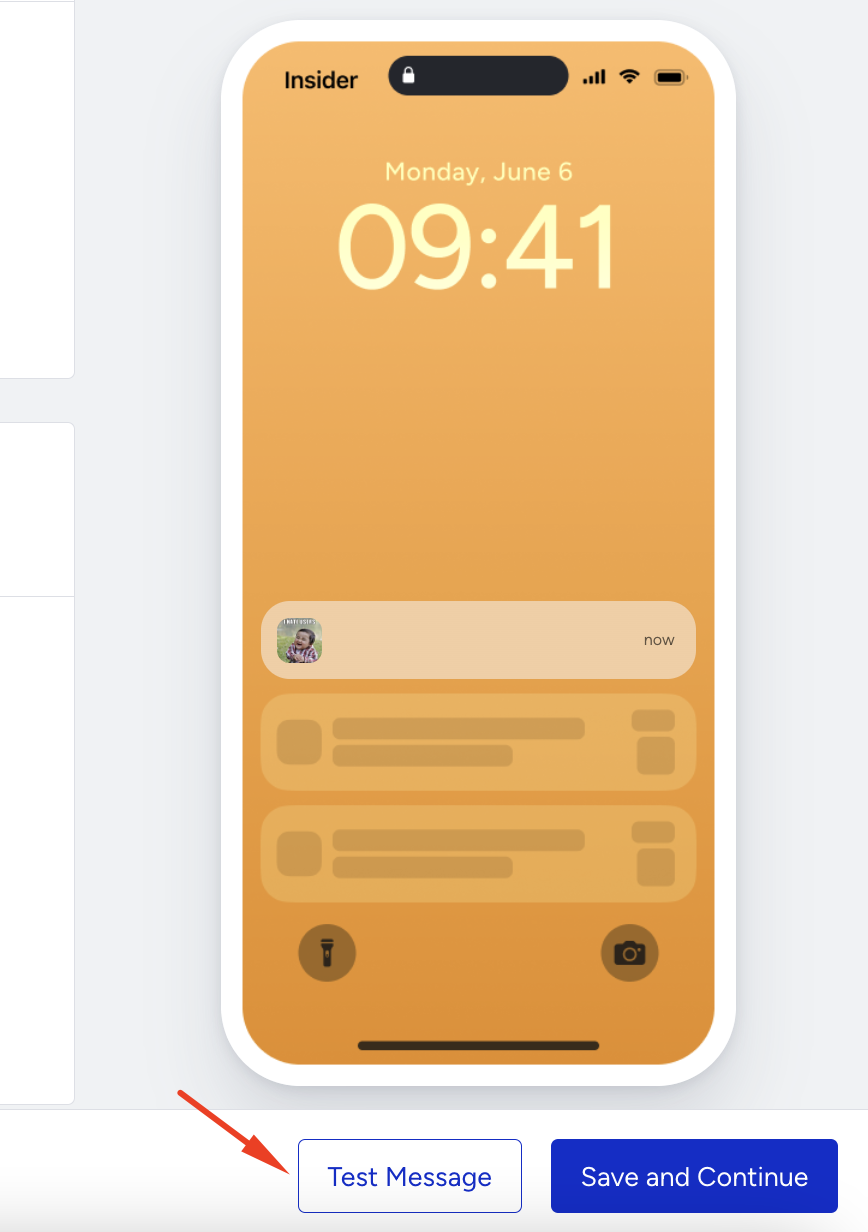
6. Select goals
The Goals step helps you create goals and configure conversion durations for your campaign.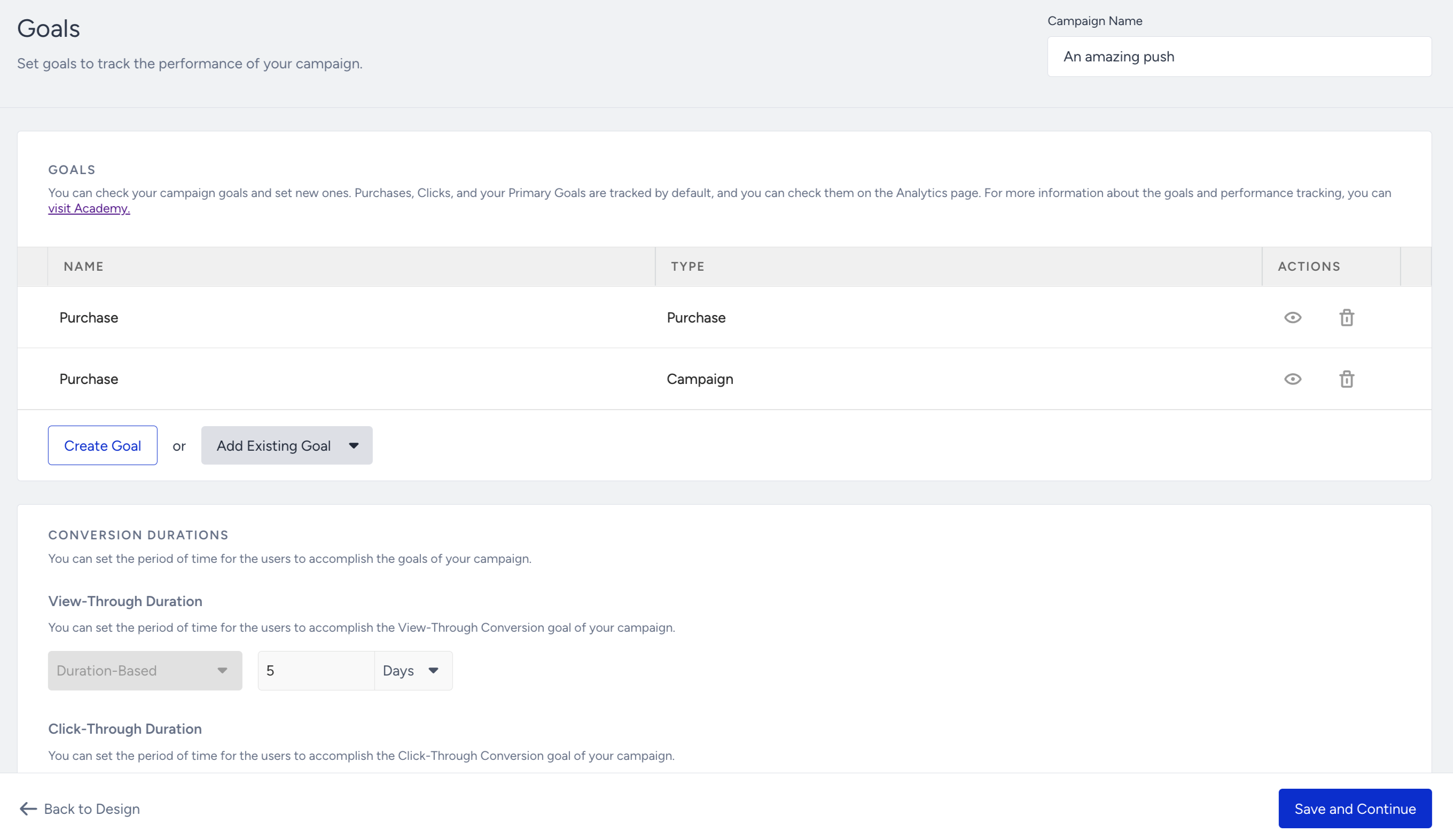
7. Configure the launch
Refer to the Launch page to configure Silent Hours, Send Time Optimization, Time to Live, Campaign Group Access, App Template Campaign Integration, Frequency Capping, Message Throttling, Notification Sounds, iOS Thread and Android Channels, and Campaign Tags.
8. View analytics
Go to the Analytics page to
View the summary metrics
Analyze the pie chart & graphs
View the variant list
Export your results
