User Engagement helps you target users likely to engage with your brand. It enables you to develop an engagement strategy that maximizes conversions and minimizes the number of unsubscribed users.
In predictive modeling, a user’s behavior is compared to the journeys and historical data of other users. User Engagement uses a machine learning algorithm to analyze user data and events (e.g., email open rates, recency, user lifespan).
The User Engagement algorithm learns from users' behavior when opening Email, Web Push, App Push, SMS, and WhatsApp messages. It predicts which users will likely open the email, push, or messages within the next seven days.
To segment your users, select Predictive Segments > User Engagement. Choose the product from the dropdown menu to target users, and set your operator to High.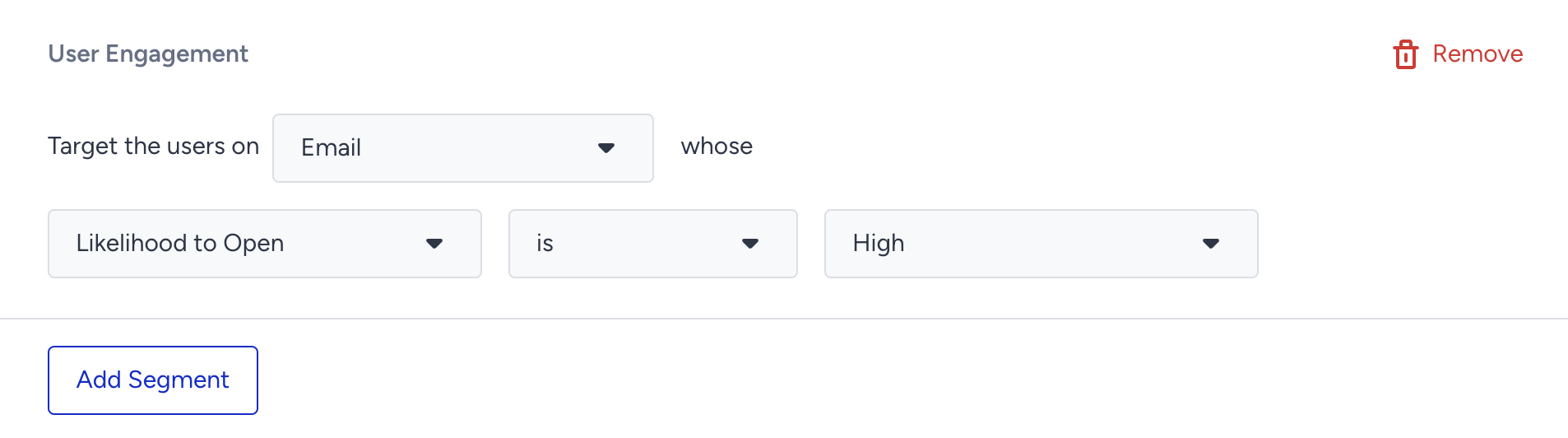
Model Details
The User Engagement model applies either a regression model for scoring engagement or a multi-class classification model to group users into High, Medium, or Low engagement tiers. It is designed to assess overall user engagement with the platform, helping inform upsell, cross-sell, or re-engagement strategies.
Model type: Regression model or multi-class classification
Segment update frequency: Daily
Data Used
The model processes historical engagement and behavior data from multiple touchpoints:
Website and app visit frequency
Email open and click-through rates
Time spent per session
Interactions with marketing messages across push, SMS, and WhatsApp
Delivered, opened, and clicked event metrics across channels
Key Features
Key behavioral indicators used to evaluate engagement include:
Email click-through rates
Frequency and depth of site or app sessions
Interaction frequency with marketing messages
To run this algorithm, you will need the required event numbers and product quantities below:
Both Likelihood to Open and Likelihood to Engage algorithms should run for all channels.
To run the Likelihood to Open algorithm for Email, you should run the algorithm for at least 30 days with at least 1000 email-delivered events, at least 100 email open events, and more than 10 email click events.
To run the Likelihood to Engage algorithm for SMS, you need at least 100 sms click events in 7 days and at least 1000 sms delivered events in 7 days.
To run the Likelihood to Engage algorithm for Web Push, you should run the algorithm for at least 21 days. The total page view event count should be above 1000 in 7 days, the Web Push click event count should be above 100 in 7 days, and the Web Push view event count should be above 1000 in 7 days.
To run the Likelihood to Engage algorithm for WhatsApp, the required WhatsApp click event count should be at least 100 in 7 days, and the WhatsApp delivered event count should be at least 1000 in 7 days.
To run the Likelihood to Engage algorithm for App Push, the following conditions must be met: at least 1000 page views and push delivered events, at least 100 push sessions on events, and a minimum of 21 days of data.
Use Cases
The User Engagement model enables precise campaign strategies:
Target highly engaged users with an upsell or cross-sell offer.
Re-engage low-engagement users with tailored content or incentives.
Adjust communication frequency and content based on predicted responsiveness.
Route users to their best channel
User Engagement predicts openness across channels: Email, Web Push, App Push, SMS, and WhatsApp. The same per-channel engagement-probability signals can be used to select the single channel a user is most likely to respond to, rather than messaging every channel.
In Architect, the Next Best Channel element reads each user's per-channel engagement-probability scores, filters to the channels the user is reachable on, and routes the user down the path for their highest-scoring channel. Users with no engagement signal follow a fallback channel if one is configured; otherwise, they are dropped at that step. Because it reuses the same engagement model used by User Engagement segments, a single journey can adapt its delivery channel for each user without you maintaining separate channel logic.