In this step, estimate how much SMS traffic you expect to send and when you expect the highest volumes. This information helps plan sending capacity and optimize delivery for your account.
Your estimates are used to provision throughput for your senders. They do not represent a billing commitment or a sending limit that you are charged against.
Your estimates are especially important during peak periods. If your actual sending volume is significantly higher than the volume you provided, the operator might throttle or filter excess traffic, which can delay or prevent message delivery. Providing a higher estimate does not add a cost.
Use your busiest realistic month as the basis for your estimate rather than your average monthly volume.
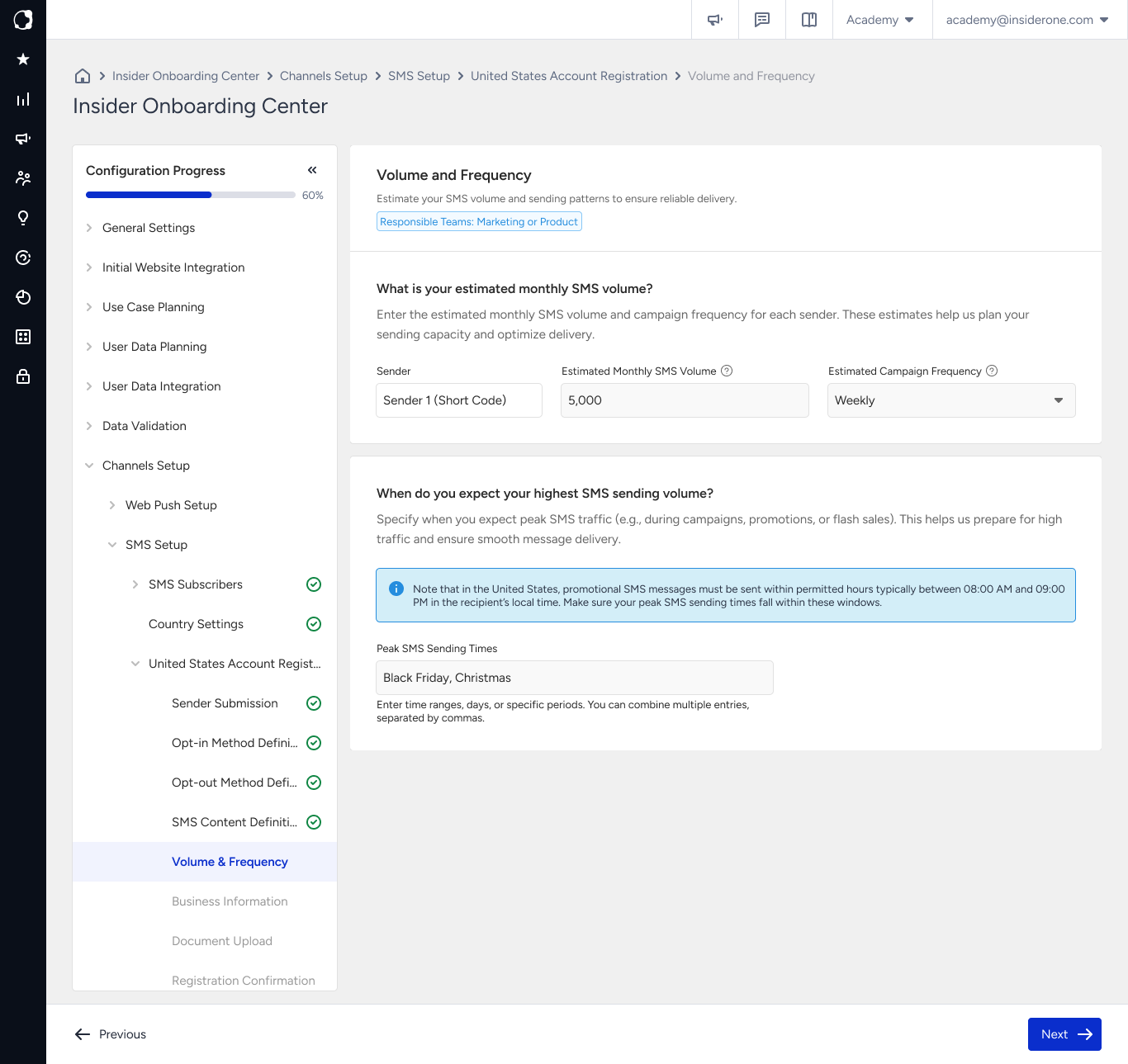
Information required for your estimate
Field | What it is | What to enter |
|---|---|---|
Estimated monthly SMS volume | The number of messages you expect to send from this sender | Enter a whole number that reflects a busy month rather than an average month. |
Campaign frequency | How often you run campaigns | Enter a frequency such as |
Peak SMS traffic | When you expect your SMS traffic to increase significantly | Enter specific periods, date ranges, or times of day. |
Provide these estimates for each sender you submitted. Promotional and Transactional senders can have different traffic patterns and should be estimated separately.
Describe your peak periods
Be specific when describing your expected peak periods. A clearly defined period helps the SMS provider plan capacity more effectively than a general reference to seasonality.
For example:
Black Friday, last week of NovemberRamadan and the week before EidChristmas and New Year, 15 December to 2 JanuaryBack to school, August
Also include recurring periods within a month that significantly increase your SMS volume, such as payday campaigns or weekly flash sales.
In the United States, Promotional SMS messages must be sent within permitted hours, typically from 08:00 to 21:00 in the recipient's local time. Make sure your expected peak sending times fall within this window.
The permitted sending window follows the recipient's local time. A campaign sent across the United States can span four time zones, so the same sending time can be early for some recipients and late for others.
For the sending restrictions that apply in your markets, refer to SMS Silent Hours.
Best practices
Base your estimate on your expected peak volume. Your SMS volume can increase as your marketing plans expand throughout the year. Providing enough capacity in advance can help you avoid needing to revise it later.
Estimate the volume for each sender separately. Transactional traffic is typically more consistent and time-sensitive than Promotional traffic. Estimating each sender separately helps ensure that campaign peaks do not affect traffic such as order confirmations.
Inform the Insider One team if your expected volume changes significantly. Events such as a new market launch or an acquisition can increase your sending volume considerably. Planning additional capacity before the campaign is easier than adjusting it while the campaign is running.
Common mistakes
Entering the volume of your first campaign: Your first campaign might not represent your highest expected sending volume. Base your estimate on a realistic peak month instead.
Using a vague description for peak periods: A general statement such as
busy in Q4does not provide enough detail to plan capacity for a specific high-volume period.Planning peak sends outside permitted hours: In markets with sending-hour restrictions, messages sent outside the permitted period are not simply delayed and might not be delivered as intended.
Next step
Continue with Business Information, where you provide the company details required for your registration.