Customer lifecycle originates from the traditional CRM practice, mapping the journey of a customer from acquisition to churn in a cyclical process. When targeted with the right message at the right time, users can evolve from visitors to potential buyers, first-time buyers, and eventually loyal customers.
Customer Lifecycle Status (CLS) classifies users into different lifecycle stages based on their engagement and purchasing behavior. It enables marketers to tailor strategies for each stage and deliver personalized messaging that nurtures users toward conversion or re-engagement. Doing so increases user retention and lifetime value through machine learning–powered segmentation.
The objective of the CLS segment is to classify users according to their stage in the customer lifecycle (e.g., active, inactive, churned, visitors, potential buyers, silent visitors) based on behavioral and transactional data.
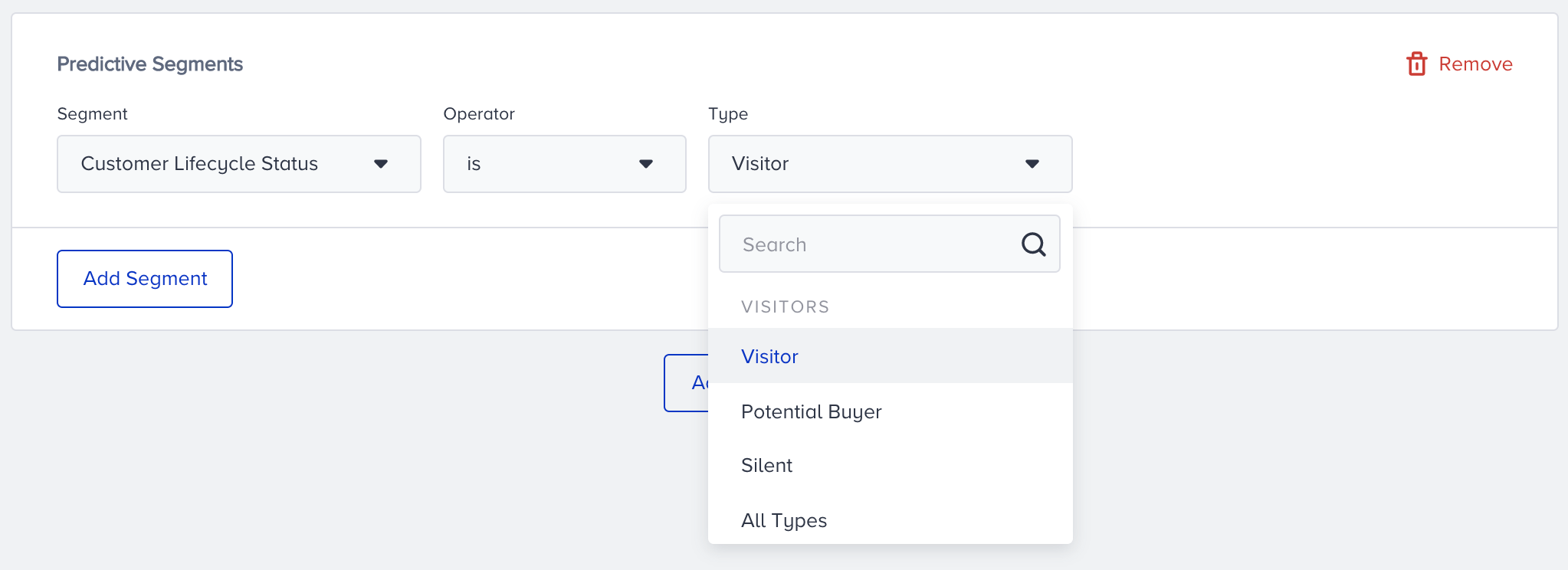
Model Details
The following model details outline how the CLS segment is calculated and updated based on user activity and historical data:
Segment update frequency: Daily
Data span: 1 year
Calculation time: 30 days
Model type: Multi-class classification model
Data Used in Customer Lifecycle Status
Session-level data, such as session duration and event count
Event-level actions, such as product page views and purchases
CRM purchase data integrated with web behavior (clickstream data)
If web or app session data is unavailable, CRM data is excluded, since in-session behavior forms the foundation of the segmentation.
CRM page_visit data will be included in the future as part of model improvements
CLS evaluates purchase activity based on transactions (i.e., completed checkouts), not individual product purchase events. Multiple products purchased in one checkout are counted as a single transaction.
Key Behavioral Features
These behavioral signals evaluate user engagement and determine their position within the customer lifecycle model.
Frequency and recency of purchases
Time since last session or interaction
Session depth and engagement
Interaction with product categories
Visitors
Visitors have the following user groups:
Visitors: New or infrequent visitors who show above-average visit behavior. For example, a user visits the site for the first time or occasionally, but navigates through multiple product categories.
Potential Buyers: Visitors who behave like buyers—frequent site visits, long sessions, high interest. For example, a user who returns several times a week and consistently explores products for 10–15 minutes per session.
Silent Visitors: Previously engaged users whose visit frequency and session time have dropped below average. For example, a once-weekly visitor visits every two months with minimal interaction.
The scenarios below illustrate how visitors might move between different engagement stages based on their behavior.
Visitors who engage more frequently or spend more time on product pages might become potential buyers.
Potential buyers with reduced engagement might return to visitor status.
Visitors who become less active might shift to the silent visitor group.
Silent visitors who re-engage might be reclassified as visitors or potential buyers, depending on their activity.
Customers
Users who have made at least one purchase are considered customers.
Active Customers: Regular buyers with consistent and predictable purchase behaviors (e.g., they make a purchase every 1-2 months). If there’s a discernible purchase pattern, the model uses it to categorize them. For example, a user who regularly purchases every 45 days and interacts with emails or promotions is considered an active customer.
If an active customer’s behavior follows a pattern where they regularly make purchases, but then stop purchasing for an extended period, they might be flagged as inactive.
Inactive Customers: These users were once active but have recently reduced their purchasing frequency (e.g., a customer who used to buy monthly but hasn’t bought anything in the last 3 months). They are considered at risk of churn. For example, a user who made a purchase every 30 days but hasn’t purchased in the past 60 days might be classified as inactive.
If a user has consistently purchased for months but hasn’t interacted with the website or made a purchase in the last two months, they might be marked inactive.
Q: Why is this user inactive even though they purchased recently?
A: A user might have made frequent purchases two weeks ago. However, if they haven't interacted with the website in the last 3 days, the algorithm could classify them as inactive based on their historical behavior.
Churned Customers: Previously active customers who have stopped purchasing for a long time and are unlikely to return. For example, a customer who used to buy once every three months but hasn’t purchased in over a year is flagged as churned.
A churned customer might visit the website without purchasing, so they might move back to an inactive status, rather than returning to the active segment.
Customer status can also shift based on how their purchasing and engagement behaviors evolve over time:
If an active customer stops purchasing for a significant period, they might transition to an inactive customer based on their usual purchasing pattern.
If an inactive customer continues not to purchase or visit the website, they might become a churned customer.
If a churned customer begins revisiting the website without purchasing, they might return to the inactive stage.
If an inactive or churned customer makes a new purchase, they will return to the active customer status.
Use Cases
Before starting to use any Customer Lifecycle Status, Insider strongly suggests you take a look at the best practices:
Keep active customers engaged and loyal with post-purchase or replenishment campaigns.
Reactivate inactive or churned customers through targeted win-back campaigns.
Give potential buyers incentives to nudge them to make their first purchase
Re-engage silent visitors with fresh content or relevant product recommendations.