Starting July 1, 2025, WhatsApp has transitioned from its current conversation-based pricing model to a per-message pricing model for template messages. Meta introduced this change to simplify the pricing structure, align with industry standards, and better reflect the value delivered to both users and businesses.
What is the per-message pricing model?
With the per-message pricing model, businesses are charged for each template message delivered, regardless of the conversation type.
Charges vary by message type:
Marketing Templates: Charged per delivered message.
Authentication Templates: Charged per delivered message.
Utility Templates: Charged per delivered message if sent outside the 24-hour customer service window, free if sent within it.
The image below illustrates how different message types are charged under the new per-message pricing model, including whether utility messages are billed or free, depending on the timing.
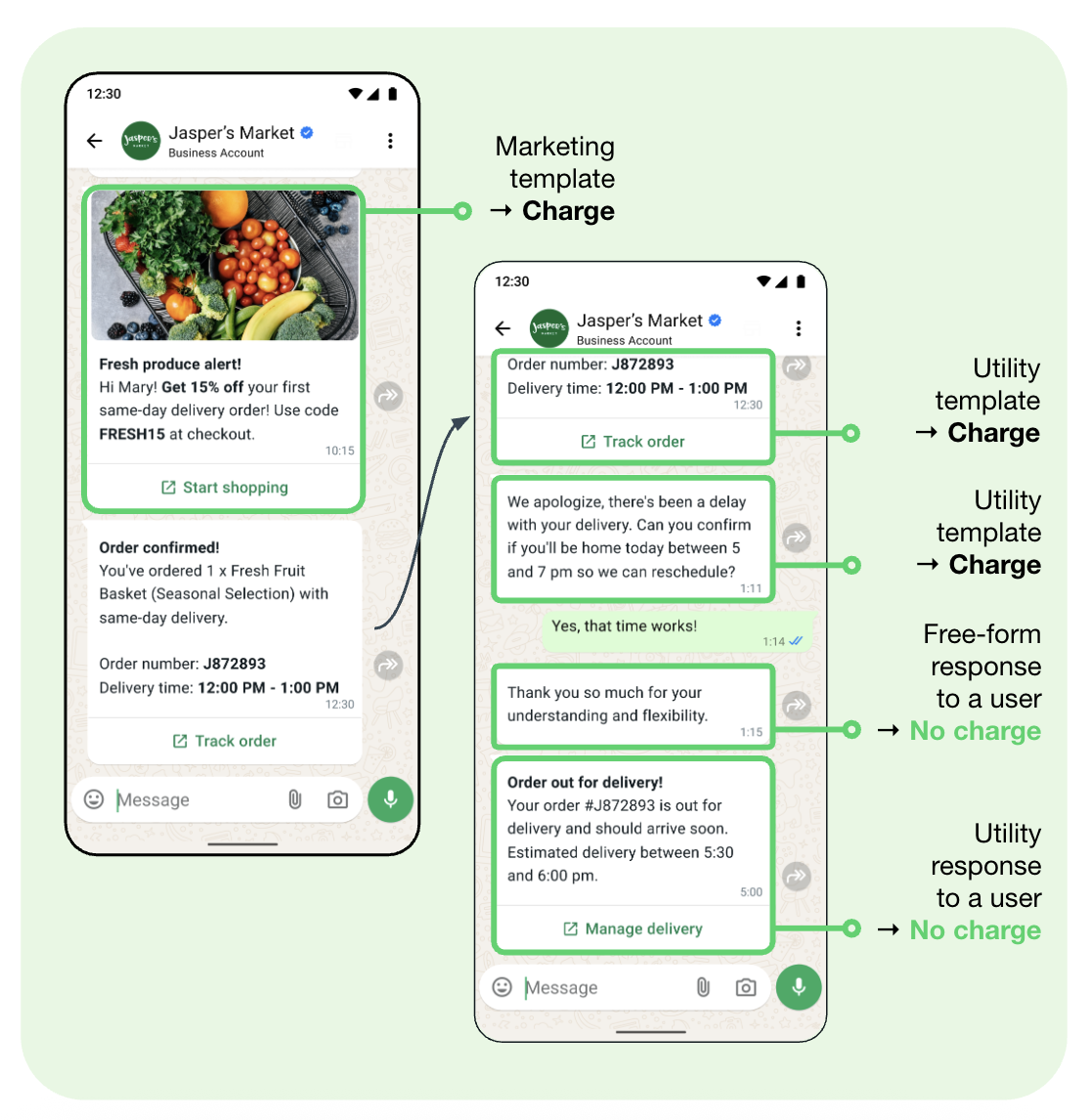
Example 1: How message type and timing affect charges
If you send 1 marketing template and then 2 utility templates to a user, this will result in 3 separate charges (1 marketing + 2 utility). However, if the 2 utility templates are sent within the 24-hour customer service window, only the marketing template will be charged.
Example 2: Comparing charges for two campaigns under both pricing models
If you send two marketing campaigns to the same 100 users within 24 hours:
July 1, 18:00 – Campaign A sent → 30 messages delivered
July 1, 20:00 – Campaign B sent → 40 messages delivered
Old Pricing (Conversation-Based):
Charged once per user per 24-hour window.
Only 40 users received at least one message → 40 charges
New Pricing (Per-Message):
Charged per delivered template message.
30 (from Campaign A) + 40 (from Campaign B) → 70 charges
Charges apply only to delivered template messages, not sent or failed ones, under both pricing models.
How is this different from the Conversation-Based Pricing model?
In the previous conversation-based model, businesses were charged per 24-hour conversation window, regardless of the number of messages sent within that period.
With the new per-message model, each template message sent is charged individually, allowing for more granular billing but also requiring businesses to monitor their usage carefully.
This shift simplifies the pricing structure and aligns it with broader industry practices. It provides businesses with greater clarity and control over their costs while encouraging thoughtful and efficient messaging strategies.
How does this impact businesses using WhatsApp for messaging?
This change simplifies pricing and aligns it with broader industry practices. Businesses will have clearer cost structures and will need to optimize their messaging strategies to manage expenses efficiently.
Will the free entry point messages change?
The service message (e.g., user-initiated conversations) remains unaffected by this change. Only template messages will follow the Per-Message pricing model.
Understanding WhatsApp Analytics Pages
Metrics in WhatsApp Campaign Analytics and WhatsApp Usage Analytics serve different purposes and should not be directly compared.
WhatsApp Usage Analytics includes all messages charged by Meta, covering:
Architect (automation) WhatsApp journeys,
Standalone WhatsApp campaigns,
API-sent messages (via Transactional or Conversational API)
This page is best for tracking Meta-charged message volume and comparing your quota vs. actual usage.
WhatsApp Campaign Analytics focuses on campaign-level performance. You can use this page to analyze:
Message delivery
User engagement
Audience reachability
For quota tracking and cost monitoring, rely on WhatsApp Usage Analytics. For performance insights, use WhatsApp Campaign Analytics.
For further information, refer to Meta’s Pricing on the WhatsApp Business Platform guide.