The Visiting Behavior segment targets users based on their previous visits to your website. It helps differentiate between new and returning users and tailor campaigns based on the recency of visits.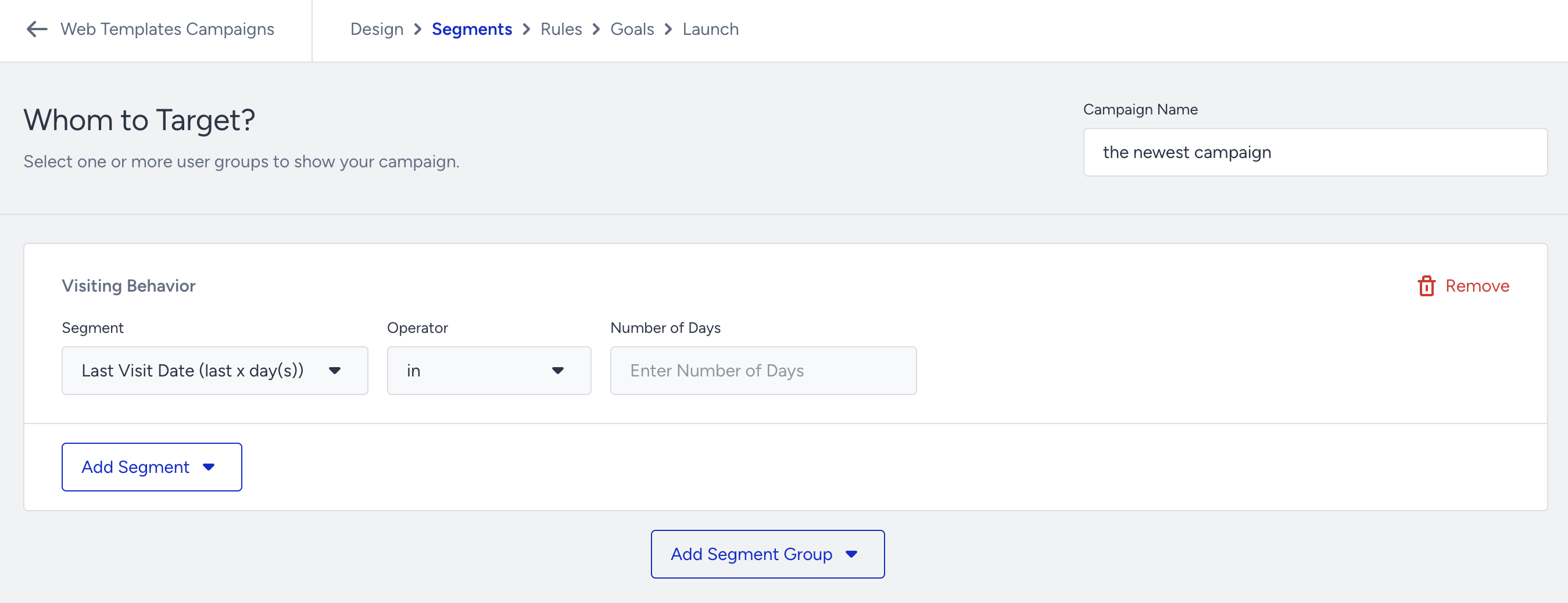
Segmentation options
Under Visiting Behavior, you can filter your users into three different segments:
Last Visit Date (last x day(s)): Targets user's last visit date in X day(s) (e.g. Last Visit Date (last x day(s)) - in - 7(days)).
Last Visit Date (during a time period): Targets a user's last visit date during a time period (e.g., Last Visit Date (during a time period) - in - 01.01.2025 - 01.02.2025).
New/Returning Visitor: Targets new and/or returning users (e.g., New/Returning Visitor - is - New User).
Technical notes
Visit history is stored in Local Storage (LS) and expires after 365 days.
Returning User Logic:
More than one LS history log = Returning user
First-time visit = New user (device/browser-specific)
Session Behavior:
Refreshing the page after a 30-minute idle period creates a new session → user becomes a returning visitor.
For example, if you visit a website today on your phone for the first time, you are identified as a new user. Subsequently, if you visit the same website on your laptop on the same day, you are also identified as a new user because the visit history is saved in local storage, and it's a browser-specific value.
If you land on the page for the first time, refreshing the page marks you as a returning visitor, as a new session starts 30 minutes after the user enters the website.
Use cases
New User Engagement
Show Hello Bar campaigns with discounts for first-time purchases and membership benefits.
Highlight top-selling categories via InStory for smoother navigation.
Inactive User Win-Back
Target users who haven’t visited in the last 30 days and offer them discounts on return.
Returning Visitor Retention
Display Recently Viewed Items for returning users to improve their browsing experience.
Remind them of items in their cart to encourage checkout.
User Feedback
Show a feedback form to users who have been inactive for a while to understand churn reasons.