Customizing an algorithm involves controlling the "calculation parameters," allowing you to fine-tune the computations to align with specific strategic requirements and objectives. This customization empowers you to adapt the algorithm's behavior to meet your strategic needs.
The Recommendation Algorithms work with the user events you've collected and the product catalog. In this context, changing the "source" or "size" of the collected user event data directly affects the algorithm's output accuracy.
To start customizing, click the Configure button in the top-right corner of the screen.
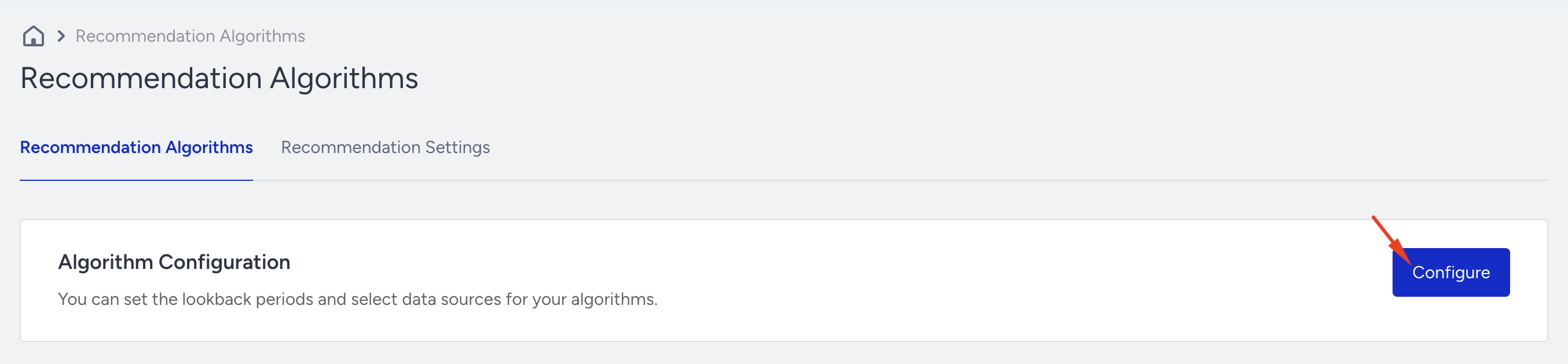
You will see two configuration options that allow you to choose the most personalized user event data set:
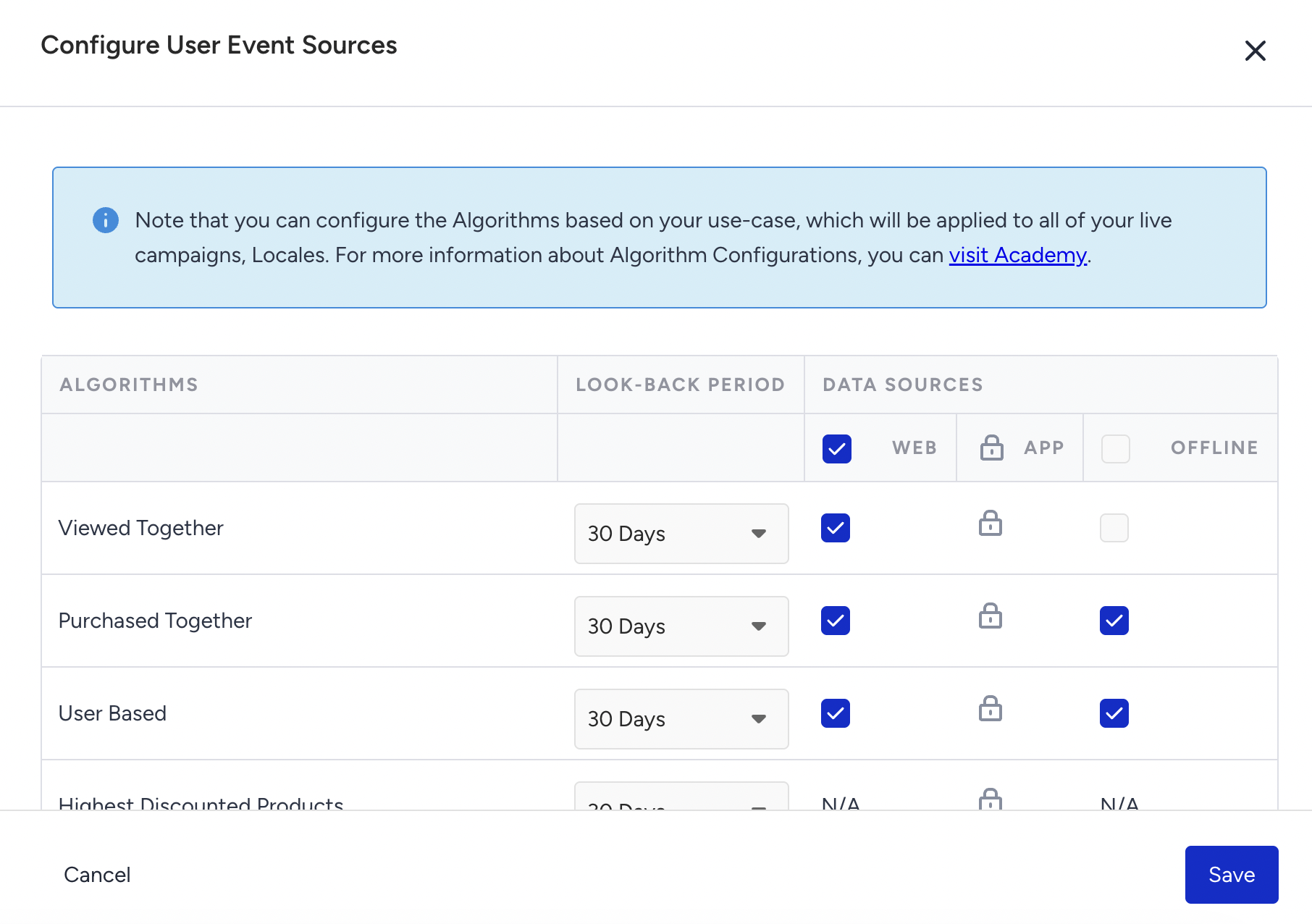
Look-back period
The time interval over which user events are collected is a crucial factor in ensuring the relevance and accuracy of algorithms. Adjusting the time interval allows algorithms to adapt to seasonal trends in user behavior. A practical example is setting a 7-day look-back period for a "Top Sellers' algorithm to create a "Hottest of the Week' campaign on the homepage.
The flexibility to choose the look-back period lets you decide how many days of collected user events an algorithm should consider. For instance, extending the look-back period (e.g., from 14 days to 30 days) becomes a strategic approach to improve recommendation accuracy during low-traffic seasons. This ensures that algorithms analyze a broader set of user events, enhancing your ability to capture meaningful patterns even in periods of lower activity.
Select the best-fitting look-back period for Recommendation Algorithms
Selecting the optimal look-back period is crucial for effective recommendation strategies. Different algorithms require varying amounts of historical data to function optimally, with some performing well with just 1 day of data, while others require at least 14 days.
It's essential to note that these recommendations are not grounded in real-life data. The best-performing look-back periods for each algorithm depend on end-users' actual behavioral patterns.
Since algorithms rely on data for optimal functioning, we recommend avoiding excessively short look-back periods for some algorithms. You should not set the look-back period for:
- The most valuable algorithm as 1 or 3 days.
- The user-based algorithm as 1 or 3 days.
- The purchased together algorithm as 1 or 3 days.
- The trending algorithm as 1, 3, or 7 days.
- The viewed together algorithm as 1 or 3 days.
User event data source
User events are the actions users perform on your website, app, or even in offline stores. Insider gathers these events from end-users who have consented to cookies on your website and app. Smart Recommender uses these events to analyze user intent and generate personalized recommendations. Common examples of user events include product page view, add to cart, or purchase.
Insider Recommendation Engine supports data ingestion from all sources, making its recommendations multi-source aware. This capability ensures that app users' recommendations are not solely based on data from web users. Instead, recommendations are tailored to users' specific attributes and behaviors within each channel, enhancing the accuracy of the algorithmic outputs. Additionally, you can personalize algorithms by specifying the channels you want to target, enabling a more fine-tuned and contextually relevant recommendation system.
In Smart Recommender, you can enhance your recommendations using purchase events obtained from your offline stores. Insider receives offline store purchase events via the Upsert API to UCD, enabling you to implement your recommendation strategy seamlessly.