RFM stands for recency, frequency, and monetary value. This method analyzes a user's past transaction data, creates segment groups based on purchase history, and measures customer value by scoring customers based on how recently, how often, and how much they buy.
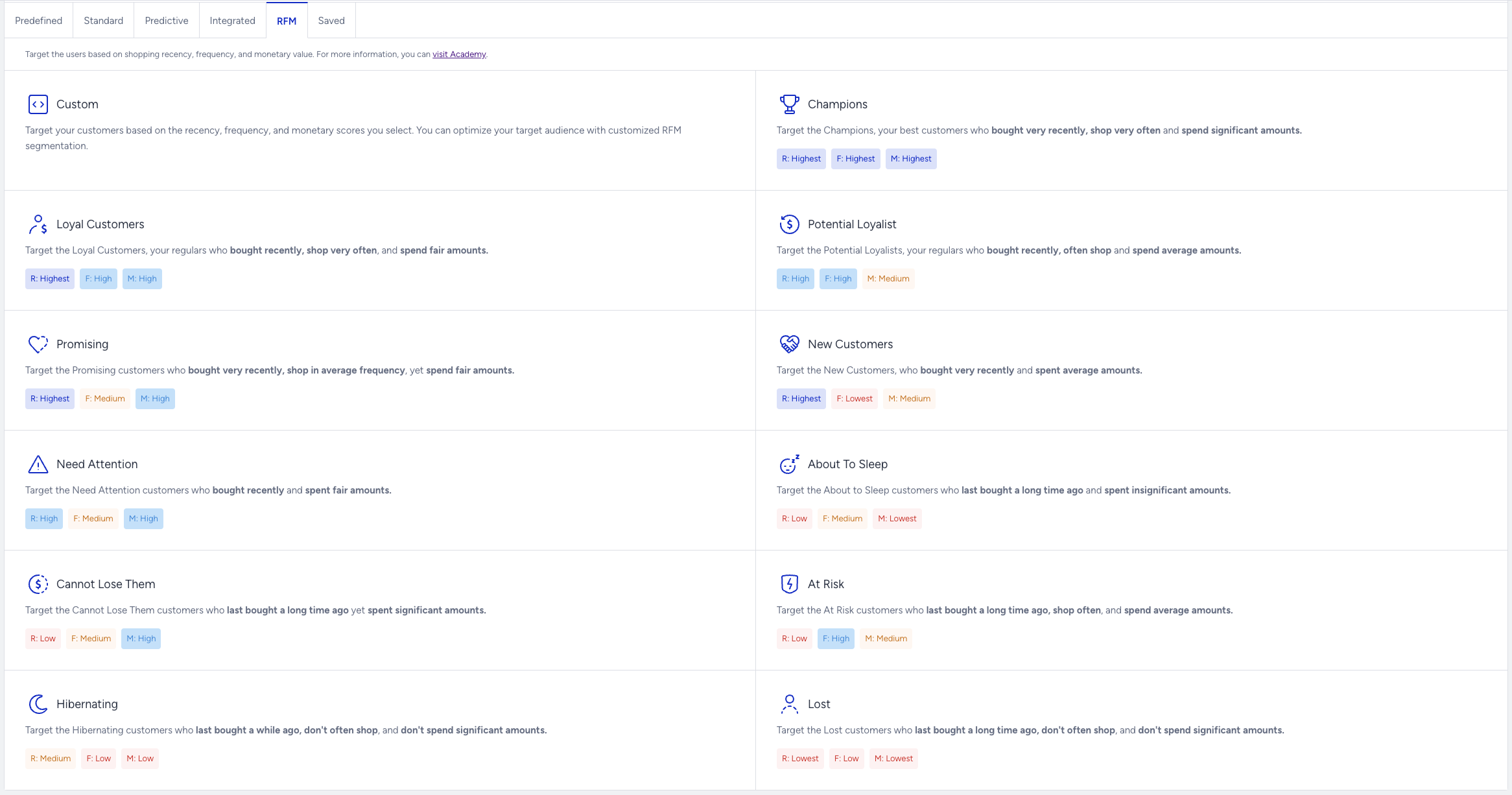
The available segments of RFM might vary depending on the product you are using.
Scoring Model
Five levels of scores are available for Recency, Frequency, and Monetary values (scores 1–5).
Total possible combinations: 125 segments (5³)
Score interpretation
5 = Highest ranking (e.g., most recent activity, highest frequency, highest spending)
1 = Lowest ranking (e.g., long inactive, low frequency, low spending)
How users are distributed across RFM scores
RFM scores are relative rankings within the eligible user population. For each RFM dimension, eligible users are sorted according to their Recency, Frequency, or Monetary value and distributed across five score levels.
5 represents the highest-ranking group.
1 represents the lowest-ranking group.
Each score level contains approximately 20% of the eligible population.
The approximately 20% distribution applies separately to Recency, Frequency, and Monetary scores. It does not mean that each named RFM segment, such as Champions or Loyal Customers, contains 20% of all eligible users.
RFM scores do not represent fixed spending, purchase count, or recency thresholds. The boundaries between score levels can change as the eligible population and its behavior change.
Definitions
Recency: Time since last purchase or activity with the brand.
Frequency: How often purchases or interactions occur with the brand during a particular period.
Monetary: How much a user spends during a defined period
Calculation Basis
Ecommerce websites: RFM is calculated based on purchases.
Non-ecommerce websites: RFM is calculated based on sessions.
RFM Segment Requirements
Data used: Only purchase behavior is used for segmentation (app, web, CRM). Behavioral data, like session views or product interactions, is not considered.
Segment update frequency: Segments are updated daily. A customer’s segment can change daily based on their latest purchase activity.
Data span: Up to 12 months of purchase history is processed when calculating segments.
RFM segment sizes can change after the daily recalculation, even when you do not change the segment configuration. Users can move between RFM segments as their activity and relative scores change. Profile removal under the applicable User TTL can also affect segment counts.
Refer to Troubleshoot RFM Segment Changes for possible causes, investigation steps, and historical data limitations.
Use Cases
RFM scores can help identify and engage a variety of customer segments:
High-spending new customers: Score high on recency and monetary, but low on frequency.
Frequent low spenders: Score high on frequency, but low on monetary value.
One-time big spenders: Purchased only once, but spent above average.
VIP customers: Score high across all three dimensions.
High-value churn risks: Score high on frequency and monetary value, but low on recency.
Low-value customers: Score low across recency, frequency, and monetary value.