Soft opt-in is the data customers share with brands when they buy or show interest in their products or services, and the brands use this customer data to send marketing emails or texts.
It does not require users to fill out a registration form, enter their data, or grant permission to receive emails. It does not require users to opt in actively to receive promotional marketing.
Soft opt-in requires brands to give the customer an option to opt out at the time you collect their data and every time you contact them for marketing purposes. The opt-out option should be clear and easy to do.
Soft opt-in allows you to target only the users who have only indirect permission to receive promotional marketing. These users should be the users who never opted out of any marketing activities from companies. Otherwise, soft opt-in regulations cannot be used.
Opt-in Surpass
Opt-in surpass helps surpass the mandatory opt-in controls for emails, including the email opt-in and GDPR opt-in. In some regions, soft opt-in regulations apply to promotional marketing.
Opt-in surpass is connected only with the Email channel. Other channels are not impacted.
When opt-in surpass is enabled, the following conditions are not checked to send email messages:
- Email opt-in is true.
- Gdpr opt-in is not false.
The following conditions are still checked to send email messages.
- The global unsubscribe is not equal to 1.
- The user has their email address as an attribute.
- The has_invalid_email has the true value.
- The spam is not equal to 1.
- The bounce is not equal to 1.
You can use the opt-in surpass in different use cases based on your strategy, such as cart abandonment, browse abandonment, post-purchase, and important days (e.g., Christmas, national holidays, birthdays, etc.).
How to use opt-in surpass
To surpass the GDPR opt-in and email opt-in controls, check the Enable Opt-in Surpass box while sending your email message.
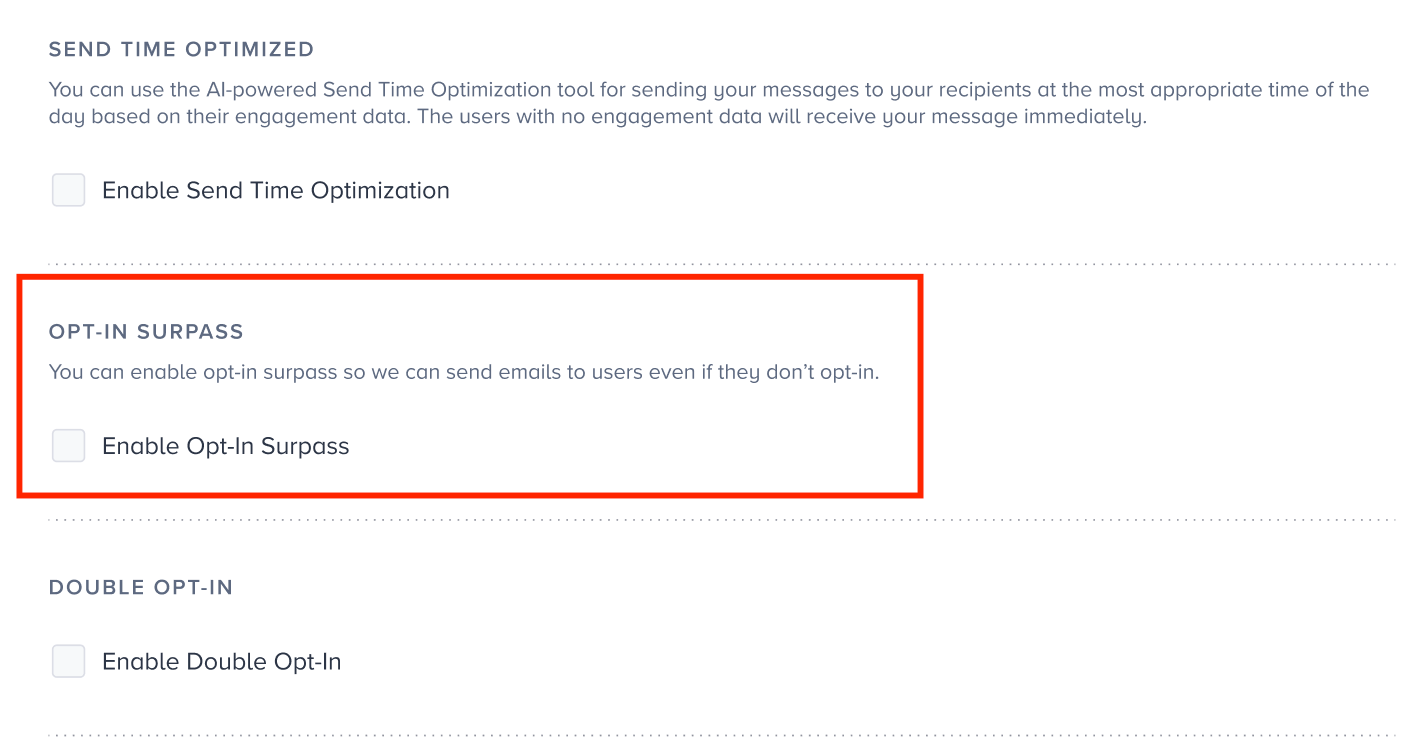
If you have multiple Email channel elements in one single journey, you should configure the opt-in surpass separately for each channel element.